A Conversation with Chris Sharp

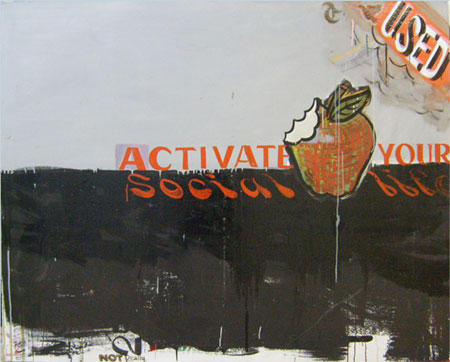
Chris Sharp is one of those artists we’ve known for a while. He was a regular at Black Water with us. He designed and letterpressed the Exit133 business cards. We loved his large canvasses covered with layer upon layer of images. We saw his work at the Hub, Rosewood Cafe, and all around town. We see his bicycles in front of our regular coffee shops. Then, last year, he won the Greater Tacoma Community Foundation’s first annual “Foundation of Art Award” and that seemed to really raise his profile in this town. Yet, we’d never really sat down with him to talk about what he does and how he got here.
How did you end up in Tacoma?
I was born in Colorado Springs. We moved around a little bit, but came to Bremerton in 1983. So I’ve been in the area for quite a while. I moved here in 1998.
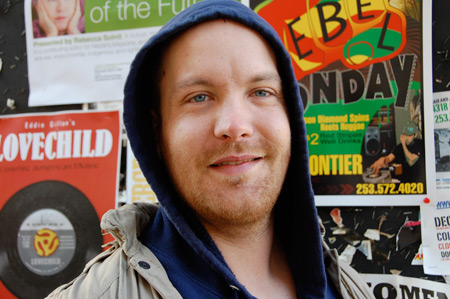
Tacoma was on the top of my list of places to go after Pullman. So after school I moved back in with my parents for a short while. Then, instead of buying a motorcycle I jumped on a friend’s apartment who was moving out. I took over their lease. It was across the street from Frisco Freeze.
What were you doing in Pullman?
I got an MFA degree from Pullman (WSU). I went for painting. I just wanted to make paintings and be in academia. I went to Northwest College of Art before that in Poulsbo. It was small and mostly about commercial art. But it had a growing fine art scene. In my second semester I decided to switch from the commercial art track to the fine art track.
We’ve known your work in many different mediums. You are a sign painter. You are a letterpress artist. You’re a graphic designer. For people that don’t know you, what do you say you do?
I tend to say that I am working artist and let them imagine what that is.
What does that mean to you?
To be a working artist, I think that you have to be one of those people that looks at everything as an opportunity to do something. And, hopefully, you’ll get paid for it. I have my own agenda and affinities, but I think working artists have to conform and make concessions as to what we’re going to do today or make at the end of a project.
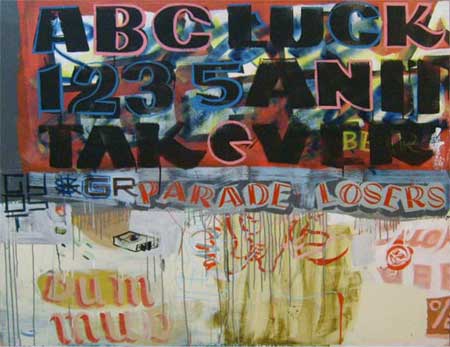
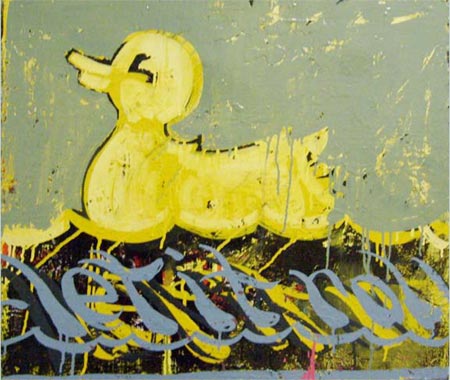
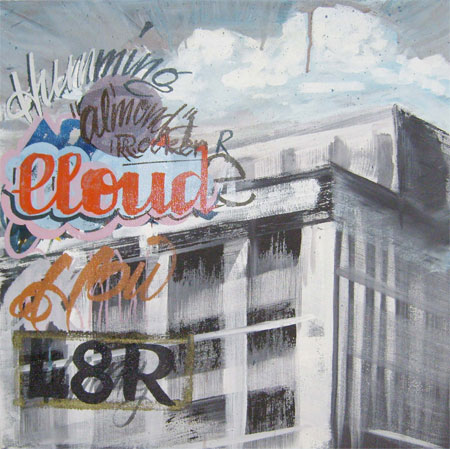
Your paintings have a very identifiable style that combines sign painting, typography, and a ghost sign like layering. When did you develop that style as your own?
It was there in graduate school. I put words into a few of the paintings for some juried shows.
But while being an undergraduate student there was this really strict regiment of, if you’re a painter, if you’re paintings about paintings, or about the paintings that we do, you don’t write words into it. You use language to communicate ideas or feelings.
I still have this dilemma that I haven’t fully reconciled. A fine art painting that has words in it is already laden with too much baggage. It’s difficult for me to reconcile. There’s all this stuff about fonts. Not to reduce it too much, but just the concept of language is good enough on its own. And then when you make a big painting with words on it, is it something people are supposed to be reading? I don’t know.
Shortly after graduate school I needed a rigid structure to apply myself to. In typography, and hand lettering more specifically, there’s a craft there. In hand lettering, you can get away with it a little bit. It’s probably better that everything isn’t exactly the same. I needed something to hold onto because in graduate school, there was so much freedom. You had to do whatever you wanted in order to sell it back to the faculty. They weren’t going to tell you, well you need to start focusing your content more in this direction or that direction. What they really wanted was to push you to be thorough in developing your content. They didn’t really read it or judge it. That’s all fine.
Toward the middle end of my graduate studies, I didn’t really have a clue as to who I was going to be. I was 23 years old. I don’t think many people know exactly who they want to be at that age … for a good reason. I stopped making art. Little by little I found things like hand letter and typography naturally across Tacoma’s landscape. Living in Tacoma and absorbing the old signs that are hidden here and there, that’s what probably precipitated the style you see.
I feel like I went backwards. Graduate school would’ve been a great thing to do after having become more established as an artist rather than the path of high school student, undergraduate student, and a graduate student.
What is your process now? Where does your spark come from?
It might just be something I see. I’ll look at some clouds and think, I saw a painting like that before and I want to try that. Or I’ll see something in a painting itself that’s really something that I’d like to explore further in my own painting. Or sometimes I’ll just be covering something up. I’ll erase something with some paint and find something new.
I hate to work via trial and error. To not have some sort of grand plan in your head seems like I’m missing the whole idea of skill. I think that the plans that I have in my head are often good. When I start to write them out and paint them, they really don’t feel as strong as the spark. So, rather than doing that, I just resolved to paint as much as I could all the time and not have ideas.
The ideas that I’ve had and held on to really tightly are the things that were holding me back. My resolution then was to get rid of the things I needed to get rid of. Forget everything. Embellish the things that work well.
Sometimes I feel like I’m starting over every day from a new canvas.
What do you think of Tacoma art scene these days?
Getting the Foundation of Art Award from the Tacoma Foundation makes it so I can’t say there’s nothing going on. I kept trying to name the piece after Amy McBride by proxy by coming up with an acronym that somehow made Amy’s name, but it never came out.
We have a lot of active people in place to support the arts. I don’t know how many other cities have something like that. Tacoma is such an insular and small city. There’s always people trying to get something to happen.
I’m in a show at the Imprompty Gallery. There are 50 artists in there. I really feel like all those people are committed to make something happen.
The Helm is really specialized. I think even in a big city like city, places like this are struggling because they aren’t fitting into the models of commerce that are viable. I sometime wonder how to make a contribution that is somehow viable.
Are there consumers in Tacoma willing and able to support local artists as artists?
I would imagine that there are those consumers. I was in a home not too long ago for a Christmas party. I noticed that there was a Jasper Johns poster on the wall from MOMA in the 1980s. Wow. As far as posters go, that was a pretty important poster. And then I started walking around and there was an Andy Warhol, a Mick Jagger, and John Wayne from the 1980s. There was some neat art here from the 1980s. These are exactly the type of people that could support a scene. But, would they buy art in Tacoma? Who’s selling art at this level?
For example, like when the Whiting Tennis / Chauney Peck show was at the Helm. Whiting Tennis is one of the best painters to come out of the area. You could’ve bought some paintings in Tacoma without having to find his work in Seattle or elsewhere. I don’t think anything of Whiting’s sold here in Tacoma. It’s strange to me.
These are all interesting philosophical questions, but I’m more interested in making what I do into a sustainable lifestyle. I want to retire debt, contribute, and make more of what I want to see. I want to make myself my own commercial client.
Are you optimistic? What gives you hope?
I think that people around us are much more endearing that we realize.
I think that it gives me hope that I’m not 100% sold on all of my work. At least I’m critical to the point of where I won’t start to rely on the same old tricks. I can grow – at least in the fine art sort of way – more and more toward some relevant direction.
My favorite piece is always the one that isn’t done yet. It’s always just out of reach. Once it’s finished it falls behind me.
Filed under: Arts
7 comments
E Erik B. March 6, 2009
I think Chris Sharp made this unique sign for Satellite Coffee
C chrisroxx March 6, 2009
actually DEZ one of the artist at Supernova through that together. We were going to make one that said“Dude, Wheres my car?”
G Grace Sullivan March 7, 2009
This is one of the best articles I’ve read in Tacoma in a while. It would be cool to see a local profile like this weekly. Thank you Exit 133.
H Holly Weiman March 9, 2009
I am happy to see articles like this, Chris deserves more than Tacoma fame. He has worked hard for his art and done an amazing job at creating a consistent look. He’s also an all-around nice guy. Nice work Sharp
T Tom Llewellyn March 10, 2009
I am such a Chris Sharp fan. I want Chris to strike it big because I think his art deserves a wider audience. I love seeing it for free around town (on signs). And I really miss the old Corina Bakery sign.
Nice job, Derek
P Peter Whitley March 12, 2009
I really want to hate Chris Sharp but damn he’s such a nice guy. Makes it hard.
If you can’t buy art, trade art.
C clara March 13, 2009
hurray for chris sharp! thank you for the article and providing some insight into this mysterious man… A true artist. congrats on the award sharp