Cecilia Beaux at TAM
In the decades around the turn of the twentieth century, Cecelia Beaux was one of the United States’ most beloved portraitists. After her death in the 1940s, Beaux’s work drifted into obscurity, perhaps a casualty of the shift in tastes away from figurative art. Cecilia Beaux, American Figure Painter, which opens tonight at the TAM, reexamines Beaux with a small but comprehensive selection of works.
The show tracks Beaux’s development from her early years in Philadelphia, through her success in Europe as a young woman, to her maturity as both an educator and a portraitist of the elite families, arts patrons, and social activists of the East Coast.
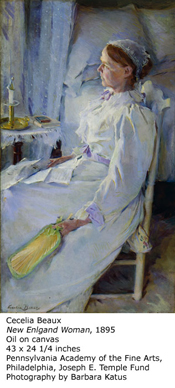
Beaux’s very early works document her talent for capturing both the physical likeness and character of a sitter. An early portrait of George Burnham (1887) reveals the artist’s struggle to integrate the human figure with the light and texture of an outdoor setting; although it’s not especially successful, this painting is an early indicator of Beaux’s desire to push herself, and the medium of portraiture, in new directions. A visit to Paris in her thirties exposed Beaux to the Old Masters and to recent French painting. But rather than drawing her to any one style, her time in Paris seems to have encouraged that experimental bent. Works like Twilight Confidences (1888) demonstrate Beaux’s interest in strikingly geometrical compositions and versatile brushwork.
For me, the show has two highlights. The first is a series of six portraits, grouped together on the wall as they would have been at the 1896 Champs-de-Mars Salon. Every work she submitted was accepted, an indication of the approval Beaux enjoyed among the Parisian audience. Each of these works is remarkable for its distinct approach to composition, brushwork, or pose. They are all quite different, and they show us that Beaux had no desire to stay static in her style.
The second highlight, After the Meeting (1914) strikes me because it captures Beaux’s ability to move between the timelessness of a formal portrait and a more fleeting moment. This casual interior scene has the sketchy brushwork of a study. The figures and background context are barely recognizable, while the foreground, including the figure of the young woman caught mid-conversation, emphasizes contrasting planes and patterns, rather than a one-to-one replication of the sitter.
Margaret Bullock, TAM’s new specialist in nineteenth-century US art, oversaw the installation of the exhibition. Bullock’s arrival signals a new interest at TAM in the nineteenth century, and we can expect to see some exciting projects from her in coming months.
Cecilia Beaux, American Figure Painter was organized by Atlanta’s High Museum of Art. It will be on view at TAM, its only West Coast venue, until January 6.
Link to Current Exhibitions at Tacoma Art Museum.
Heather Mathews is an art historian and Assistant Professor of Art at Pacific Lutheran University. She specializes in German art of the Cold War and writes about contemporary art, most recently for Glasstire.com, an online journal of visual arts.
4 comments
M morgan January 30, 2008
Darn! I missed it!
S sassy mcbutterpants January 30, 2008
KUOW (and all NPR stations, to my knowledge) has all of their shows archived in easy to stream audio file things.
Just go to www.kuow.org and check it out. Today. Tomorrow. 100 years from now.
S South 5 January 30, 2008
It’s great that KUOW is showcasing Tacoma, but where has our own KPLU been? When you search the KPLU news archives, they’ve only done one local story about Tacoma in the past month (on Jan. 7) while the rest are focusing on Seattle. I know they have a newsroom up there (and maybe a bigger funding base), but KUOW isn’t scared to show some T-Town love. By the way, which radio station helped to sponsor the Tacoma Film Festival this year? That’s right, Seattle’s KUOW.
S sassy mcbutterpants January 30, 2008
south 5, you are so right. As I understand it KPLU’s News Department is based out of Seattle, and most of them live there as well. They even share reporters with KUOW from time to time.
I think the bigger challenge for KPLU is that their signal reaches from Vancouver BC down to Oregon. Not only does Poor Adam Gherke (tiny crush, ok?) have to find traffic reports relevant to satisfy that wide audience, but spreading the news report love around might be tricky as well.