Code Changes to Protect Tacoma's Historic Resources

Proposed changes to Tacoma’s Minimum Buildings and Structures Code are now making their way through City processes, and will likely soon appear on a city council agenda near you. Hopefully these changes will prevent other historic buildings from going the way of the Luzon.
Some of the more interesting changes (the first to the Code since its implementation in 1999) would affect the way the Tacoma deals with historic structures. For example, one section would have the City’s Historic Preservation Officer “actively pursue feasible intermediate alternatives to total demolition” in emergency cases. It also adds a new definition of a “historic resource” as any property that appears to be eligible by the HPO for listing on the local, state, or national registers of historic places.
In a letter to the Commission, Historic Tacoma expresses the organization’s support for those elements of the new code that it says will better protect Tacoma’s historic buildings. The letter goes on to identify areas that the group feels need further attention, asking that the revisions be referred back to staff for further review.
- Broadening protection of historical resources
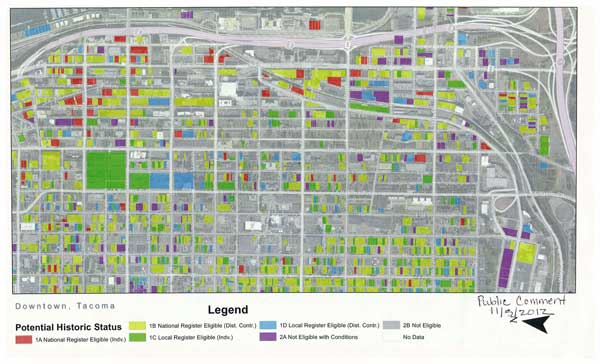
The new definition of a “historic resource” has been added to the Emergency Cases section to include potential historic landmarks to the categories of buildings getting additional attention from the HPO. Historic Tacoma asks that the term also be included in sections of the code dealing with derelict and dangerous buildings, asking that Code Enforcement notify the LPC when a historic resource is designated as derelict or dangerous, just as would be done in emergency cases. A GIS-based Cultural Resource Inventory has recently been partially completed (check out the pretty image above), identifying potential historic resources in Tacoma. Historic Tacoma asks that the Inventory be referenced to identify historic resources that are at risk.
- Encouraging environmental responsibility & re-use
Historic Tacoma also asks that when a building has to be demolished, the City adopt a policy of deconstruction and salvage for re-use of historic building materials.
- Public Notice
The letter further points out that no mention is made of public notice in instances of dangerous buildings hearings and emergency cases. A notification process, Historic Tacoma suggests, could help mobilize resources to avoid demolition. Ideally, the group would like to see a searchable public database of derelict and potentially dangerous buildings and their status.
There is still some reviewing to be done; changes won’t go before Council for a first reading until the second week of December the ordinance didn’t receive a do-pass just yet, so we’ll wait and see where it goes from here. It does sound like the City may be open to a more proactive approach; according to the TNT City Manager Broadnax’s goal is to create an “early warning system” with Code Enforcement and Historic Preservation working together to identify buildings that need saving.
Taken together, Historic Tacoma’s suggested changes could help do just that: identify historic properties at an earlier stage, before they become dangerous, and possibly help to preserve them. Taken with other changes in the Code that would shorten timelines for complaints, and levy heavier penalties on repeat offenders, the enforcement side could be strengthened.
Could we actually end up with a historic preservation code with some teeth?
Filed under: Legislation, City Government, Tacoma Landmarks
5 comments
J Jesse November 17, 2012
One of the problems with having a historic building is that the city pretty much demands that if it is remodeled or upgraded that there are certain things that must be done in accordance to the buildings historical character… so I understand. That’s great on paper, in a historical or city staff meeting, or by the public’s perception but it might not be so great with the owner who can’t afford those things.
The problem I see with historic rehabilitation laws is that they’re front-loaded in the sense of what must be done to the building if a remodel happens. Therefore, if you get a building that’s too expensive to remodel because of this, it sits… and sits… and sits until it isn’t viable for a remodel but rather a demolition and just selling the vacant land so the project will “pencil out”.
As well, an old building has other issues besides historic laws. They often need to be lead abated at a significant cost, wiring is often ancient knob and tube, and pipes can be lead or even clay (outside).
I think it’s important that the pain inflicted in sitting on a building and letting it rot until it’s necessary demolition day needs to be amped up. Basically, it needs to cost the owner far more to sit on one of these structures and demolish it by neglect that it does to restore it. Not just the historic guidelines are important, but the other issues need to be looked at, by the city, as well.
F fred davie November 18, 2012
Jesse, I would tend to agree with your posting. If our society really wants to preserve these old buildings then we need to step back and take a hard look at the numbers.
One of the numbers you didn’t mention but which I think is relevant is the cost of labor. We have established a price of labor which I believe is detrimental to the preservation of historic structures. It might be possible to completely refurbish a historic building using minimum wage labor and yet be impossible to refurbish the same building using prevailing wage labor.
Apparently there is an inverse relationship between the cost of rehabilitating a historic structure and the likelihood of rehabilitating a historic structure.
Liberal employment policies are probably dooming many otherwise salvageable buildings.
J Jesse November 19, 2012
@ Fred: Exploiting desperate workers with minimum wages in this economy is not the solution.
Private sector rehabs need not pay prevailing wages. Only the gov’t is dumb enough to waste money on prevailing wages that are way over market rate.
R Reuben McKnight November 19, 2012
Thanks for the thoughts.
Although it is true that a historic rehabilitation budget tends to cost more in skilled labor than new construction does (new construction invests more in materials, often sourced from outside the local economy), it is a misconception that historic buildings are too expensive to rehab because of “historic requirements.”
There are many factors affecting the costs of rehabbing older buildings, historic or not. For example, full code upgrades that are triggered by either the substandard building abatement process, by overall construction project value, change of use, or by the intended use (retail versus restaurants, residential versus offices). An unreinforced masonry building may be subject to seismic upgrades, egress requirements (including pressurized stairwells and elevators), sprinkler systems, energy code upgrades and so on.
Some of these financial hurdles can be addressed through amendments to city codes, including land use, building code, and our enforcement code. We’re working on those factors.
Other tools we already have, including our local property tax incentive and the Federal Investment Tax Credit for historic rehabilitation, actually add value to a building if it is historically designated by potentially lowering operating costs and bringing in equity dollars at the front end.
J Jesse November 20, 2012
Arent things like seismic upgrades, lead abatement, and other full code upgrades with older buildings pretty much always problems in older buildings and therefore historic rehab requirements? I mean, the historic codes and the problems with historic buildings are one in the same. Perhaps the rules for each reside in different city departments but the costs all land in the building owners spreadsheet.
I’m glad all things are being looked at.