County Conducts Jail Release Analysis
One of the topics that often comes up when we talk about downtown development, or a lack of development, is the placement of the jail and the correlation of its location with increased crime in the surrounding area. In order to provide some data for this discussion, Pierce County staff recently conducted an analysis of the issue. They specifically looked at persons who were SIP’d and persons with multiple arrests in the area around the jail. The results were presented in today’s Pierce County Criminal Justice Task Force Meeting.
Special Identification Procedure (SIPs) is the process where an arrested person is brought to the jail, technically booked, identified, fingerprinted, given a citation to appear in court, and then released.
Research questions:
- How often are persons who have been SIP’d are later arrested in the Hilltop or other nearby areas?
- Of the SIP’s later arrested in those areas, how many persons had been arrested outside of Tacoma prior to be SIP’d?
The study looked at numbers from 2006, 2007, and the beginning of 2008.
Study Area:
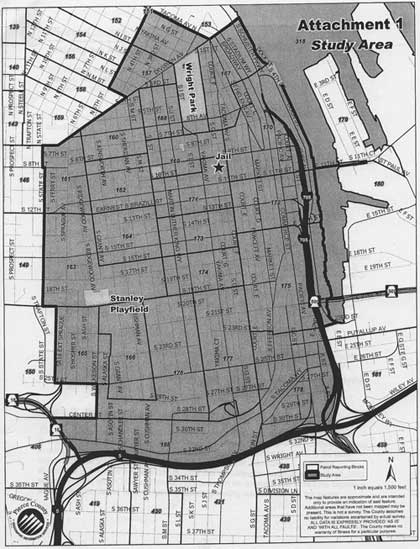
Findings:
- The total number of SIPs for 2006 was 867, and for 2007 was 3,166. Of these numbers, nearly half were for driving related offenses. (Driving with License Suspend/Revoked, etc)
- In 2007, the year with the highest total number of SIPs, 210 people were rearrested in the study area, only 6.6%.
- Of those 210, 75 were rearrested in Hilltop.
- 33 of the rearrests, those who were SIP’d and released in Tacoma, were originally from outside Tacoma.
- The 33 rearrests of offenders originally arrested outside of Tacoma were broken down into time periods between arrests. 6 were rearrested within 10 days of their original arrest and SIP process, 23 were rearrested after 30 days or more.
The conclusion of these initial findings was:
Based on the above data, we conclude that the arrest data provides little support for the concern that SIPs are having an adverse impact on public safety in the Hilltop and other areas of central Tacoma.
Because of these findings, the rearrest numbers were analyzed to find a better answer.
Approximately 20% of individuals made up 43% of the arrests in the study area. In numbers that means 946 people were responsible for 2,765 arrests.
Who are these folks?
Based on records, it appears approximately 30% of repeat arrestees are homeless or transient. The high percentage was a surprising result according to the study’s author. Those who claim an address at a shelter (Nativity House, King Center, Rescue Mission) accumulated roughly 2% of the arrests. Those who are homeless or transient, and do not claim any address make up nearly 27% of the total “frequent flyers”.
The complete report can be found here with a previous memo and data here. (pdf)
So what’s the answer?
Filed under: public-safety
7 comments
L laura Hanan July 21, 2008
I know from first hand experience with individuals that were arrested, released, rearrested, and convicted that many return to this neighborhood because I see them again on the street. Not all of them are transients – many of them have lived in the neighborhood but been evicted.
They return to this neighborhood because they can get away with it. They are here to recommit crime, especially drug dealing. It is basic supply and demand – they go where they have been successful in their business.
Commerce is one of the busiest streets in Tacoma and it’s not because it is a scenic drive.
L laura Hanan July 21, 2008
I meant to add to my comment that I think that the answer is a combination of the community, businesses, and the police actively working together to reclaim neighborhoods and blighted areas.
Much nuisance behavior is tolerated by the police and the community which erodes the fabric that makes up a safe, diverse, and inviting place to visit, shop, and live.
I intacoma July 21, 2008
^ lets all start a youtube channel and post “crime” videos ha
E Erik B. July 22, 2008
Interesting study.
On an initial positive note, at least there is some kind of effort to reduce the relatively high crime rate in Tacoma and Hilltop and examine the role roaming jail releasees contribute to it.
Perhaps the report can lead to preventing crime instead of simply reacting to it.
In 2007, the year with the highest total number of SIPs, 210 people were rearrested in the study area, only 6.6%
I am not sure if they should have used the term “only.”
If the study area included all of Tacoma, the number of people being re-arrested would have increased. The smaller area looked at drives down the number.
A better question may have been how many people are re-arrested in the City of Tacoma who came in from outside the city.
Based on records, it appears approximately 30% of repeat arrestees are homeless or transient.
Not surprising since many released felons and sex offenders identify themselves to the state as being transient.
N NSHDscott July 22, 2008
Rearrests aren’t the only measure of negative effects. First of all, not all repeat offenders will be rearrested. Second, the mere presence of criminal types can encourage others to break the law, and discourage people like us from spending time in the area, thus limiting its potential for improvement. They don’t have to be actively breaking the law (again) and getting caught (again) to have a negative effect.
Ultimately, do we really need to conduct studies to know that rounding up law-breakers from all over and turning them loose in one area is a bad thing? Isn’t it just common sense?
R Rollie July 22, 2008
I am a member of the Pierce County Criminal Justice Task Force. After we were presented with this report we had the chance to discuss its findings and methodology. The report consists of two memos, the second answers questions raised by the Task Force in its discussion of the first. The summary posted here on Exit133.com does not include several of the most important facts and findings from the study:
1. SIPs are by definition charged with minor offenses (over 43% were driving related, for instance driving without a license).
2. SIPs in the study population who were re-arrested were all charged with minor offenses.
3. “Frequent Flyers” (including especially those who are transient/homeless) are for the most part repeatedly arrested for minor offenses (the more serious offenses on the list were more likely to have been committed by one-time offenders).
In other words, there is no mention of the types of charges to which the SIP release method is applied, and no mention of the fact that chronic offenders for the most part are arrested over and over again for minor charges, as is the case across the country. We were also informed that the jail does not SIP individuals at times of day when Pierce Transit is not operating in downtown Tacoma.
We discussed at length the findings that a large percentage of the Frequent Flyers are listed as transient/homeless and what that means for the County:
1. The lack of available services to address mental health and drug/alcohol dependency needs is a major problem for our county.
2. Programs such as Housing First help to provide ties for the transient/homeless to the community. Those with strong community ties are less likely to commit crimes.
I must admit that the results of this study surprised me (and I believe a number of other Task Force members). After spending time around the jail both by myself and with the Tacoma Police Department I felt that the “Catch and Release” process did cause harm to the area around the jail and the Hilltop. The data does not support this assumption. I suggest that everyone reads both memos fully prior to drawing any conclusions.
S Sally Perkins July 22, 2008
The fallacy in the data is that it focuses on “arrests.” Many crimes are committed for which an arrest is never made. Just ask those of us who call 911 with regularity—how many times does our call result in an arrest? Not very often, as TPD must personally observe the illegal activity to make an arrest. 3000+ SIPs dumped onto Tacoma Avenue and into the Hilltop do indeed contribute to a high crime rate and a sense that in this area, a person can get away with just about anything—and even if s/he gets caught, will be SIP’d out of the Jail (again). Using arrest data to “prove” anything here is not valid.