Draft Transportation Master Plan Ready for More Public Input
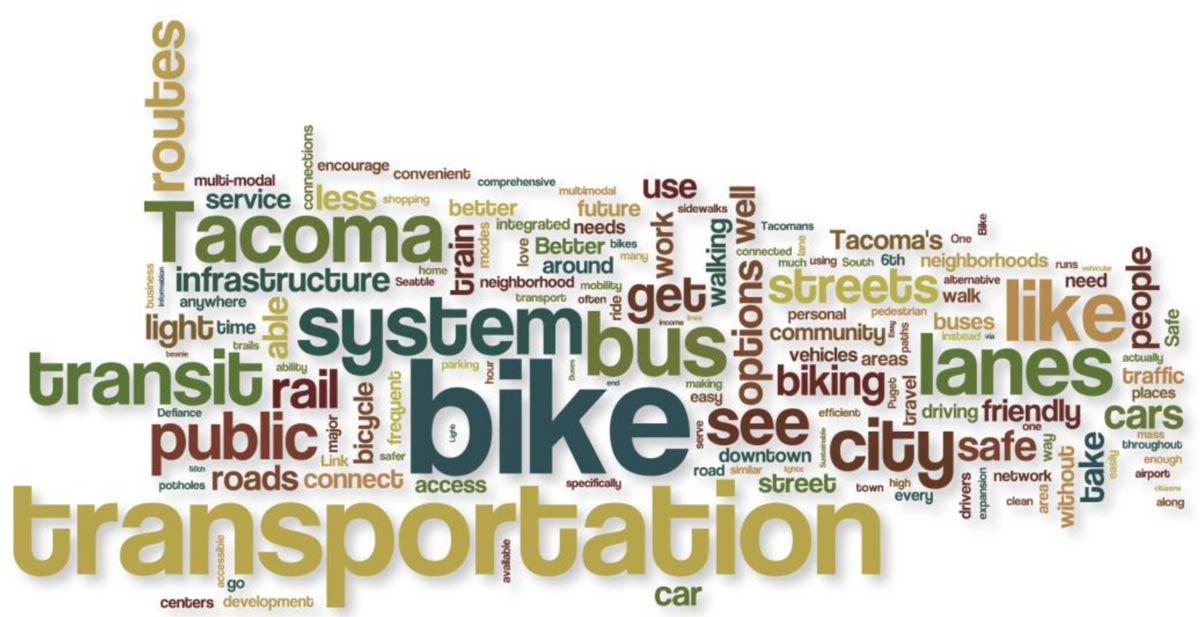
The citizen volunteers on Tacoma's Transportation Commission, along with City of Tacoma staff, have been hard at work developing the first draft of a plan that will guide decisions about transportation in Tacoma for years to come. The Draft Transportation Master Plan is now ready for public review - and comment.
After taking public input on concerns, recommendations, and priorities for transportation improvements in Tacoma, the Commission and staff developed the draft plan, which gives a high-level vision of major corridors and backbone networks for all travel modes, and explains where improvements to the network are needed to support Tacoma's long-range growth strategy.
The draft TMP lays out how Tacoma will accommodate future growth, and the accompanying growing demand on transportation systems. Inclusion in the plan is also necessary for projects to be eligible for state and federal grants.
The Plan’s role is to help the Tacoma community consider its transportation systems, how well they’re functioning and what needs, including funding, will be necessary over the next 20 years and beyond.
COMMUNITY OUTREACH RESULTS
The draft TMP includes a list of priorities and values that came out of the initial round of public process, listed as 10 items describing a community vision for transportation in Tacoma.
- A transportation network that prioritizes people over cars.
- Innovative and equitable reflecting the rich diversity of Tacoma.
- Not harming actual vehicular mobility.
- Preserve the heavy haul network and streets where trucks are allowed, specifically around the Port.
- Emphasize mass transit while encouraging local economies and community.
- A better, more comprehensive light rail system.
- More frequent buses covering more of the city, better infrastructure for walking and biking.
- Efficient, regular, reliable, multimodal connections between Tacoma’s neighborhood centers and mixed use centers.
- Better streets, equitably improved, that serve all Tacomans.
- Truly walkable neighborhoods with reasonable transit options to go farther when needed.
These basic concepts guided the commission as it developed the TMP. Also included in the full plan are key public priorities for each specific mode of transportation.
As a comprehensive plan for transportation in Tacoma, there are a lot of overlapping and at times conflicting interests. There's a lot going on in this document that attempts to address those interests. We see some interesting strategies around layered transportation networks and the 20-minute neighborhood concept.
LAYERED NETWORK
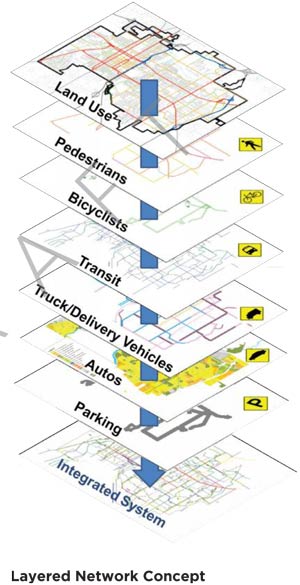
The draft TMP acknowledges that it's often a challenge for a single road to meet the demands of all modes of transportation. To address this challenge, the commission adopted a concept in which the key corridors and routes for each mode are represented in their own networks, which are then layered over each other.
It is often a challenge for a single roadway to meet the demands and expectations of all modes at any given time. This has certainly been the case in Tacoma, where the city streets have been expected to concurrently serve autos, trucks, pedestrians, bicycles, and buses. In response to this challenge, this TMP has been developed using the concept of a ‘layered network’.
Layered networks recognize that while all traveler types need to be accommodated within a community, no single street can accommodate all transportation users at all times
Some roads will clearly be critical to one mode, and less so to others. In other places, however, there will be overlap, where a particular road will be of high value to two or more modes. In these situations, the plan uses a matrix to visualize the priorities for a particular roadway.
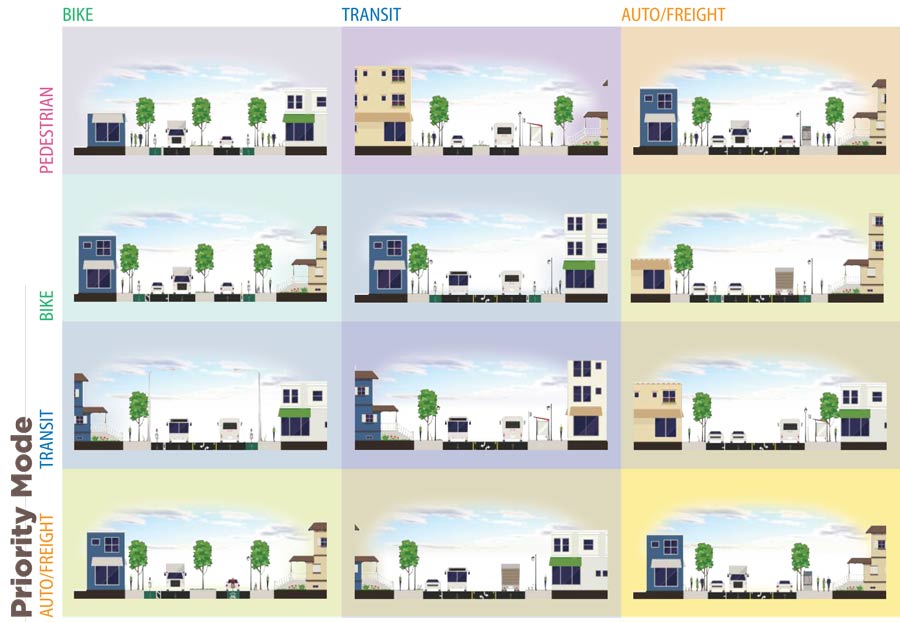
Pedestrian use is always a top priority, but the other modes may vary in their prioritization. The matrix shows the higher value mode for each situation on the left, with the secondary modes listed along the top of the grid. Each cell represents a spot where needs overlap, and the different possible dynamics. For example, the second cell down in the far right column shows a situation where bike traffic and freight routes overlap, with bikes taking priority. In the cell on the bottom left, on the other hand, the same two modes come together, but this time freight gets priority.
The street layouts shown in the grid don't represent a street design standard, but instead represent an overall philosophy to how different modes might be prioritized and accommodated.
20 MINUTE NEIGHBORHOOD
Another interesting concept included in the TMP is the idea of the 20-minute neighborhood. This idea is based on the idea that most Americans won't walk more than a mile (or about 20 minutes) to any destination on a regular basis. The TMP draws 20-minute neighborhoods around Tacoma's designated growth centers, areas that will see the most population growth and where the most destinations are locate - areas likely to serve the greatest number of people. While some level of pedestrian accommodations are slated for all Tacoma streets, standards for pedestrian facilities within the footprints of these neighborhoods are higher.
FURTHER PUBLIC COMMENT
These are just a few of the concepts included in the draft Transportation Master Plan. There are a lot more ideas and strategies listed for achieving a vision of a Tacoma with a safe, sustainable, multimodal transportation system that promotes healthy living.
The transportation network laid out is an aspirational vision for getting around Tacoma in the future, but it's the framework for a strategic approach to transportation investments in the years and decades to come. At this point you won't see any block-by-block, project-by-project list to check for your favorite pet project. What you do see, though, is the philosophy that will guide decisions on where to make investments to have the greatest strategic impact.
It's not set in stone yet, either. This draft has been posted for public feedback, and a series of upcoming workshops will give the public the opportunity to learn more, ask questions, and give feedback. Among the questions the Transportation Commission and City staff have for you are these two:
- Which streets need to form the backbone network for each mode (transit, bike, auto, freight)?
- Do the goals reflect your vision for Tacoma?
Think about it. Tell them what you think. And while you're at it, we're curious to know what you think too...
Learn more, including viewing the full draft TMP as it stands at this point at cityoftacoma.org/tmp.
Attend a Workshop
Monday March 23
6 PM - 8 PM
Freighthouse Square
2501 East D Street
Monday March 30
6 PM - 8 PM
Lincoln High School
701 South 37th Street
Thursday April 2
6 PM - 8 PM
Truman Middle School
5801 North 35th Street
Thursday April 9
6 PM - 8 PM
Gray Middle School
6229 South Tyler Street
Thursday April 16
6 PM -8 PM
Jason Lee Middle School
602 North Sprague Avenue
Thursday April 23
6 PM -8 PM
Tacoma Nature Center
1919 South Tyler Street
- 3/23 6-8pm - Freighthouse Square (2501 E. D St.)
- 3/30 6-8pm - Lincoln High School (701 S. 37th St.)
- 4/2 6-8pm - Truman Middle School (5801 N. 35th St.)
- 4/9 6-8pm - STAR Center (3873 S. 66th St.)
- 4/16 6-8pm - Jason Lee Middle School (602 N. Sprague Ave.)
- 4/23 6-8pm - Tacoma Nature Center (1919 S. Tyler St.)
To view the plan, visit cityoftacoma.org/tmp Email comments to: tmp@ci.tacoma.wa.us
Filed under: Transportation, City Projects, Get Involved, Transportation Planning
23 comments
J JDHasty March 16, 2015
T tacoma1 March 17, 2015
J JDHasty March 17, 2015
J Jesse March 16, 2015
E Elizabeth Burris March 17, 2015
J JDHasty March 17, 2015
X Xeno March 18, 2015
D Dan Hansen March 17, 2015
J JDHasty March 18, 2015
X Xeno March 18, 2015
J JDHasty March 19, 2015
X Xeno March 19, 2015
J JDHasty March 19, 2015
J JDHasty March 19, 2015
X Xeno March 20, 2015
J JDHasty March 20, 2015
X Xeno March 21, 2015
R RHTCCComedyfan March 19, 2015
J JDHasty March 19, 2015
R RHTCCComedyfan March 22, 2015
W Worker March 24, 2015
Janet Higbee April 20, 2015
J JDHasty April 20, 2015