Expansion Possibilities for the Link

Sound Transit is in the process of completing an alternatives analysis for the expansion of Tacoma’s Link light rail, and they’re looking for feedback.
The current Link is 1.6 miles in length, with 6 stops. Trains run every 12 minutes during the day, and Sound Transit claims to have served nearly one million passengers in 2011.
The Sound Transit 2 ballot measure approved by voters in 2008 included an expansion of the Tacoma Link. The analysis now underway considers alternatives for that expansion, and will ultimately lead to the selection a preferred corridor, along with a project financing plan.
A Tacoma Link Expansion stakeholder group provided alternatives in a report completed last year. Sound Transit has also completed a technical analysis of potential routes.
This isn’t going to be a cheap project, and will need federal funds to become a reality. A major source of federal funding is the Federal Transit Administration’s “New Starts” program, which will require an alternatives analysis (AA) to compare alternatives to answering needs. Phase I of the AA is underway now, and will include open houses this month to get feedback from the public.
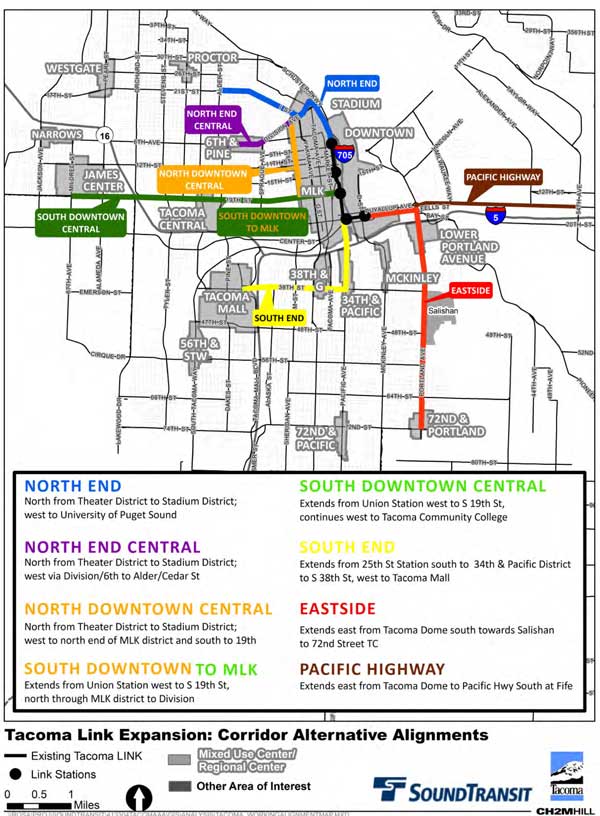
The stakeholder group identified six potential corridors and assessed them based on six identified objectives, with priority given to serving underserved communities and serving Tacoma neighborhoods, and with economic development as an overarching priority.
Where does a Link expansion make the most sense to you?
TACOMA LINK EXPANSION ALTERNATIVES ANALYSIS OPEN HOUSES
Wednesday, August 22
11:00 a.m. – 1:00 p.m.
People’s Community Center, 1602 S MLK Jr Way, Tacoma
and 4:00 – 7:00 p.m.
Tacoma Dome Station Plaza (off 25th Street)
Read more at www.SoundTransit.org. If you can’t make it to the open houses, you can still take the online survey and submit comments (pdf) through September 17.
Filed under: Downtown Tacoma, Transportation, Neighborhoods, Link, Link Expansion
49 comments
S SassAndSweet August 17, 2012
Based on the proposed choices: Up (South) on Pacific Ave and a cut over to the Tacoma Mall. Opens up the mall to the downtown area and increases shopping/revenue opportunities for Tacoma.
J Jim C August 17, 2012
Community demand for public transit is much greater on the south and east sides. The preferable routes seem like a no-brainer to me – with the added benefit of easing pressure on some of the city’s highest-traffic arterials around the mall and on the south end of downtown.
E Erik Hanberg August 17, 2012
I like the “North End Central” along 6th—really dense housing with good transit-oriented development already there.
And I like the Eastside route a lot too. Both those would be great extensions. Although all of them would probably be fine … although I have doubts about the Pacific Highway route. I’m less certain anyone would ride that.
J jsisbest August 17, 2012
North End Central would target the dense housing of the Stadium District, provide better access to Wright Park, draw from both the North End and the north side of Hilltop, and better connect 6th Avenue businesses and UPS with downtown. This route would significantly increase ridership and make Tacoma’s most vibrant urban neighborhoods stronger.
I see little reason to connect downtown with the Tacoma Mall. The Mall is already well accessed with bus routes, and the bus network better serves the Mall by casting a broader net of service.
The East Side option would help stimulate economic development in some neighborhoods that could really use the help. If the number one economic priority is stimulating growth outside of downtown, the East Side is the clear winner. The benefit to the East Side may be great (including some probably unwanted gentrification, if the Light Rail in Seattle is any indication), however the benefit to downtown and the city as a whole would be greatest with the North End Central route.
S Stadiumite August 17, 2012
I love the idea of connecting it to the “Entertainment Capitol of the Northwest”. Talk about riding the link to place people want to go! It would make attracting conventions easier, as this would be the only convention center with access to a Casino.
During the day it would allow park and ride use of the lot for DT workers and during large events at the Dome and LeMay.
It would connect hotels like the LaQuinta and the planned EQC hotel to the Convention Center addressing Tacoma’s shortage of accessible hotel rooms.
@JS – I’m not sure that gentrification would be seen as a bad thing along Portland Ave. They don’t have the overarching identity like Hilltop and 6th ave that we would be destroying. Instead you would grow businesses and attract residents and give the area a solid identity.
Going East would return the most $$ in new investment and supporting current downtown development.
J Jesse August 17, 2012
To run this out to the suburbs defeats the entire purpose of a streetcar vs a bus. It needs to stay in the downtown grid – for now.
A streetcar isn’t just an alternate to a bus, it:
1. Creates rails in the street so you can see the route.
2. Businesses feel good about that route not changing and therefore build their businesses along said route.
3. It attracts a higher income class rider and therefore businesses wanting to be along a higher end transit corridor.
4. It attracts development along the route and the stops in the form of dense housing units.
Where would all of these things be the most important in Tacoma? Downtown.
If the streetcar goes down 6th avenue, are you ok with seeing buildings demolished to make way for 4-6 story mixed use centers or would building be better served happening downtown? Downtown.
Where in Tacoma is a person most likely to sell their car and use exclusively a streetcar – therefore freeing up $700 (the average cost of a car) a month to live and work along the tracks? Downtown.
If there are tracks out to the suburbs and an unfinished network of tracks in the core of downtown, does that make downtown a destination for that suburbanites? Only within about 4 blocks from the tracks.
In my opinion, the streetcar should go up Stadium Way and turn onto Tacoma Avenue. Run the 2 mile length of Tacoma Avenue. Then turn back onto Jefferson north and back to 17th and Pacific Avenue. A loop.
Then the next route should be a cable-car loop (or single line) from Dock Street up to MLK business district via 15th street OR from the Murray Morgan Bridge to MLK up 11th street.
I would NOT run it down MLK BECAUSE OF the hospitals either as that is ridiculous – if there are other reasons, that’s fine. Go to the hospital area and look for people in scrubs at the close by restaurants. Look for patients there. There aren’t any. Hardly any. The hospital may as well be an island. Doctors don’t take lunch. Nurses very rarely take lunch – and it’s usually from a drug rep. Patients are often in financial turmoil because of their illnesses and don’t go shopping or do lunch afterwards. This run would be used for coming and going to work at the hospitals by young employees living downtown only.
The grid downtown needs to be completed so that when future tracks out to the suburbs are done, than downtown is the destination of the lines.
S Stu August 18, 2012
I like Jesse’s (#7) thinking about the Stadium loop best.
Eastside route would be advantageous if it ran down McKinley or Pacific. Be a nice shot in the arm for the south/east end. As now proposed, route is too far east.
Running light rail to the mall? Meh. Can’t see it making a significant difference for the typical mall crowd. Now, for the workers who run the registers at the mall….
6th ave seems too expensive due to congestion and disruption to existing businesses.
Pacific Highway is too industrial, not enough people. Where’s the need?
C Chris August 18, 2012
I am throwing my support behind 6th Avenue.
Lower 6th Avenue has a great mixture of walkable, people friendly uses, along with a thriving business district. It also has a great concentration of housing. Right now Tacoma Link isn’t as effective outside of commute hours because there isn’t much housing around it. 6th Ave is a prime location for attracting ridership from both the North End and Central Tacoma. North and South of 6th Avenue you will find diversity in incomes, age groups, and racial makeup.
A 6th Avenue extension would also help link schools together. Students are some of the most reliable users of transit. UWT would be linked with SOTA, UPS, Stadium High School, and Evergreen Tacoma. Imagine the possibilities for Running Start students with a line completed to TCC.
6th Avenue would be a great choice, and it appears to enjoy a lot of support.
What I want to stress to supporters of other lines is that it is critical that the first extension be an enormous success – so that the public can be confident that light rail is an investment worth continuing. I think that the popularity of 6th Avenue makes it the right choice at this time.
B Bill Kaufmann August 18, 2012
It’s a shame none of the options shown connect to Tacoma’s major hotel corridor on S. Hosmer. It would not only help residents but also help with booking more events at the GT Convention Center and Tacoma Dome. Sadly another example of Tacoma’s dysfunctional, fragmented approach to planning.
T tacoma_1 August 18, 2012
That’s funny. I must’ve missed the major hotels on S Hosmer the last time I was in that neighborhood.
And I agree with Chris on the 6th Ave alignment. His reasoning seems sound to me
J Jesse August 18, 2012
I vote North Downtown Central if I have to pick from the list. 2nd choice from the list is 6th Ave.
Are these potential lines devised from experts or the public? What do the experts in the field (urban planners) say?
Won’t the Puyallup Tribe build out the rail on the T-Dome end of the line to the lower Portland Avenue area. I thought they offered that years ago. Building rail south of Salishan on that red line seems flat out wasteful.
C Chalky White August 18, 2012
No offense @Bill, but if the King Oscar Motel and the Red Lion on 84th represent Tacoma’s hotel corridor, that would be dysfunctional.
M Michael August 18, 2012
I like the 6th Ave. route as well for the reasons Chris and Erik mention — it’s most likely to be well-used and create support for a larger future expansion. I hope the city makes this a top policy and budget priority.
C Council watcher August 18, 2012
I must agree with some about going East. Salishan is Tacoma’s best development using urban planning principles. It is a very dense community with a high propensity for ridership.
I would also bet more people go to the EQC than to 6th ave each week. Heck, if it could prevent us from building more surface parking for convention center and Tacoma Dome it is worth it.
T Tacomamama August 19, 2012
In the short term the 6th Ave merchants will not thank Sound Transit for all that construction. As much as I would love having a streetcar that came practically to my front door, I would hate losing any of those vibrant businesses.
The East Side route has the advantage of having few operational businesses at the moment, with the greatest potential for economic improvement after the track is put in place. Portland Ave is more or less wide open right now, and East Side residents could really use the transit.
S Susanne Marten August 19, 2012
I would like to see more data re: traffic flow in/out of Tacoma’s urban center from the suburbs. It would also be helpful to understand the impact of the transit center (56th and South Tacoma Way and on) for traffic flow. Another factor is the use of exits 72nd, 56th and 38th to circumvent I-5/City Center for south and north destinations beyond the City of Tacoma. During afternoon commuting the taste of carbon monoxide is not particularly pleasant in the southend hood.
A Albert August 19, 2012
It seems all of Tacoma can benefit from this, but the folks in the South and East will benefit from it for work and educational related purposes the most. The folks in the North End will look at it more as a novelty item and not a useful one, not entirely, but for the most part. 6Th ave. is not wide enough to work on this and keep businesses happy at the same time. The folks in that part of town have more resources to get around, one of them being money, which buys nice cars, which they happen to like and break down less. The folks in the South and East can use it to go to work, school and access to downtown. Portland avenue seems a bit out of the way and does not have the necessary density. It seems like a great route for an express bus service, but not rail service. Not enough density. 38Th street has the perfect set up in place. It is wide, travels through a very dense neighborhood and heads right into the mall, a major destination for many people that work and shop there. A potential station directly in the Lincoln business district would bring back the true character and develop the potential of an area that is already making a comeback. It seems that if the rail is extended North, it will only bring those folks to downtown and then what? I could be wrong, but it seems that North enders shop and eat either on 6Th ave., or the Proctor District for the most part and they like it that way. The South and East also needs more revitalization and this could drastically help. The North end is pretty well situated, as far as revitalization goes. 38Th street makes the most sense to me from a practical point of view. It seems that a mall would be the perfect end point to a rail system. The rail would actually go to a destination that is heavily used on a daily basis. It would finally give the rail a true purpose in this town other than for joy rides.
L Leif Haslund August 19, 2012
The Link expansion should be tied into the Point Ruston Project. We have a beautiful waterfront with hotels restaurants and now new businesses. You tie them into the downtown core with hotels museums convention center and T Dome. At this time there is no transportation to or from this area to downtown.
T tacoma_1 August 19, 2012
First Hill street car is one Seattle extension. What/where are the other two?
A Albert August 19, 2012
Transportation is a good idea to Point Ruston, but simply look at the numbers and density. What place in Tacoma at the moment draws the amount of people the Tacoma Mall does on a given day? People on the way to the mall have already determined they are going to spend money on small and large ticket items. On top of that there is the density surrounding the tracks, due to its close proximity to neighborhoods. Stadium district is great, but once they get on the rail, where will they go? Downtown? and do what? Maybe spend a couple of bucks at a bar? Most bars are popping up on Hilltop these days. The museum draws nowhere nearly, as much money as the mall. The mall is a place with tangible return, while downtown is nice, but where is the return. People need to start thinking about exploiting the great areas we have in our great town and detox themselves from this downtown dream. We are a city on a hill that most people do not like to hike, because it rains most of the year. Portland has great districts that are linked by rail and downtown is used for business. We can do the same here. What would be really great is if all these destinations could be linked in a loop, or go all out and combine two of these lines so that if you start at Stadium, you could end up at the mall. Then you are really starting to serve a very large portion of the population of all income brackets. Maybe it can be done.
T tacoma_1 August 19, 2012
Loops take too long. No one but a tourist at Disneyland voluntarily rides around in a circle.
I like the 6th Ave alignment because it serves a dense and diverse area, and could be the backbone of transit service in Tacome. Add in a bike share program and local bus service as ribs, and both hilltop and the north end can be served by one line.
It’d be a great start to a future streetcar network. IMHO.
J Jesse August 20, 2012
If a streetcar goes through the 6th avenue business district, where will all the parking go? That’s an awfully narrow area for a streetcar.
“No one but a tourist at Disneyland voluntarily rides around in a circle.” — tacoma1
One of the most successful streetcar lines in America, the one many cities model their system after (from Portland), is in a bent up loop… or travels one direction on a street and the opposite direction on another street two or three streets over so as the track “touches” more possible storefronts. It’s actually how a streetcar should be built. Building both back and forth directions on one street (like it is in Tacoma now) is a waste because you can use the same amount of materials but “touch” twice as many storefronts if the system goes only one direction on each street.
J Jesse August 20, 2012
Essentially, having tracks going in one direction on one street and the other direction on another street a few streets over creates a four block wide transit corridor instead of a two block wide transit corridor when you put both directions on the same street. Get it?
Since a rule of real estate is that commerce grows on main transit corridors, isn’t it wise to have a loop?
J Jake August 20, 2012
I think a good route would be up Division to MLK. North on MLK. West on 11th to Sprague then either cut over to 6th Ave or use South 8th Street at as a transit street and cut over to 6th at Pine (taking out Taco Bell with it)
C Chris August 20, 2012
“Since a rule of real estate is that commerce grows on main transit corridors, isn’t it wise to have a loop?” -Jesse
The problem with loops is that you actually shrink the pedestrian shed. You provide high levels of service within the area surrounded by the loop, but outside of it, you degrade service because it takes longer to walk to the stop on the other side of the line.
If we were using a Local Improvement District to fund the line, whereby local businesses would pay a premium to be on the line, it would be advantageous to create a loop so that it has the ability to generate more revenue from LID funds. It’s possible that we could do that, but then it’s a question of what business district would be willing to pay for such an LID.
A Albert August 20, 2012
We recently arrived back here from NYC, after being gone for many years and maybe things have changed, but it seems that downtown shuts down after 5. Maybe someone can enlighten me and tell me where all the folks along the 6Th Ave. Route will go on the rail after they get on. The mall stays open until 9 PM most nights, 7 days a week. It seems that many, many people will ride it and late into the night. It will have a useful purpose.
T tacoma_1 August 20, 2012
I could easily go the rest of my entire life without ever setting foot inside the Tacoma Mall again. I mostly despise that place.
We certainly don’t need to spend our tax dollars to build a transit system that would ensure that the owner of that urban blight becomes even richer.
J Jesse August 20, 2012
^^^ What tacoma1 said ^^^^
F fred davie August 20, 2012
This squabbling over which neighborhood should have a streetcar is kind of like a bunch of kindergardens squabbling over who will get the only purple crayon. A smart kindergarten teacher will figure out how to find a low cost source of more purple crayons.
If the COST PER MILE of construction could be drastically lowered in some way then every neighborhood could have a streetcar route. With prevailing wage construction techniques it’s doubtful that every neighborhood which wants a streetcar line will ever get one.
F fred davie August 20, 2012
“We certainly don’t need to spend our tax dollars to build a transit system that would ensure that the owner of that urban blight becomes even richer.” tacoma1
In one thread you recommend the expansion of transit because it saves on fossil fuels. Then when somebody claims that transit to the Tacoma Mall would save a lot of passenger car trips (i.e. save fossil fuels) you change your position and claim that funding such a route would enrich the owner of urban blight. If a route to the Mall would prolong the supply of fossil fuels what difference would it make who owned the mall?
Pretty sure the stores at the mall have counterparts in Seattle and you seem to like having transit run to Seattle everyday. Doesn’t that enrich the owners of Seattle’s urban blight?M Michael August 20, 2012
I like Jake’s idea @26 of getting to 6th & Pine by coming up from the south (but maybe 12th up Alder/Pine rather than 8th) — seems like something that should be considered in the analysis..
T tacoma_1 August 20, 2012
Ok
I am willing to soften my previous comment about the Tacoma Mall getting a rail line. I’d be for it as a 4th or 5th (certainly not the 1st) alignment extension.
A Albert August 20, 2012
Sometimes it is difficult to depict a persons emotions based on writing alone. I am in no way arguing this point in a negative manner and appreciate the fact that most people here feel the same way. I would still greatly appreciate someones input, as far where will be the destination of the folks on the line if it were to be built along 6Th ave, or stadium district be. Would this line see more use than a line to the mall. I am by no means a mall person, but many workers and students that attend UWT are, as hundreds of people on any given day. This might actually turn the mall around and make it a better shopping area. Thank you all for writing in on this, even if we don’t agree, we can still be civil.
T tacoma_1 August 20, 2012
Route 1 bus on 6th ave is constantly packed. The bus to the mall, not so much. Plus if the streetcar has signal priority and doesn’t follow a circuitous route or a loop, it would be competitive time wise with cars. A person can spend a lifetime at 6th ave stop lights.
And 6th ave is shy on parking, the mall has a billion parking spots. It would be easier and as fast to take the train to 6th ave than to drive. Even if the train went to the mall, it would be easier and faster to drive.
D Derek M. Young (the other Derek) August 20, 2012
Erik B – not to dwell on this because I think light rail has too many advantages to ignore, but BRT is not just an “extra bus”. In fact it basically it looks and acts like light rail except on wheels. It would not just be a supplement to Pierce Transit’s local system. The commitment would still be millions in new infrastructure (dedicated lanes, grade separations, stations, etc) but you’d get longer distances from it.
That said, light rail is a more obvious signal to encourage redevelopment as many are discussing above. It seems like BRT would be more appropriate for lines exiting the urban core, but that’s well into the future.
Anyway, this is the sort of thing ST needs to hear. I’ve probably read more thoughtful and substantive input on infrastructure in this comment section than I have in 14 years of local government. I’m impressed.
C Chalky White August 21, 2012
Before some of you dismiss the 38th Street route to the Tacoma Mall, be mindful of the possible positive impact this could have on both downtown and the 38th Street corridor through the international district. I’ll also say that people who think they’re too good to ride the bus aren’t entitled to streetcars in their neighborhoods.
A AreteTacoma August 21, 2012
BRT is the obvious choice for the 19th St route, due to the fact that buses can negotiate hills that streetcar cannot. Hilltop, 6th ave and any other downtown lines like Tacoma Avenue should be built with streetcars, while links to the mall, or to suburban areas on major arterials that have little or no onstreet parking like 19th, Pacific avenue etc would be well served with bus rapid transit. That said, the first extension should be 6th Ave. Due to the dense housing in the stadium district it would imediately become a commuter line rather than a Downtown circulator. A Portland Ave line would be all about future growth, but it takes time for growth to happen and if the line isn’t an imediate success, Tacoma may never get another.
A AreteTacoma August 21, 2012
Another thing I’d like to address is the fact that many of us (myself included) are thinking a bit too much about who will have better access to Downtown for work, entertainmnet etc, but we also want to ask where would current and future Downtown residents want to go? My money is on 6th avenue for a number of reasons. 1) Downtown does not have great parks. Streetcar access to one of our best parks, Wright Park would be huge. 2) Downtowners want to live an urban lifestyle (less car reliant). Our largest private employer is Multicare. Many professional nurses and doctors would view Downtown as a more attractive place to live and they would have the income to afford the fancy condos and apartment that uban developers like to build. 3) There is a lack of shopping downtown. 6th Ave would more than double the options for shopping and dining. If we want Downtown to be a more vibrant and attractive place to visit, or locate a business, we need more people living there. This could be a huge spark to start a self-reinforcing cycle of business and housing development both downtown and on The Ave and the better off Downtown is, the better off the city as a whole is.
A Albert August 21, 2012
56% of folks that ride the bus lines make a combined income of 20k a year. The current bus route on 6Th Ave. runs until about 8 PM, the 38Th route until 5PM on Sunday. On Saturday every hour, if they miss the bus they have to wait another hour. If a new budget is not approved to increase revenue, this will get worse. I believe the folks using the line to 38Th on to the mall are in that 20k bracket, while the 6Th Ave. folks are more than likely not. If we are going to focus on medical personnel and individuals with money buying condos then they are not in that bracket. The people that work and shop at the mall could really benefit from this when it comes time to earn a minimum wage and get to work to the mall on a Sunday evening, or back home. They deserve it more than we do in the Proctor district, or 6Th Ave. To many this is not a cute thing, but something that will help them earn a living wage. Let’s not forget about the low income hard working people that render us the services that we take for granted. They should get to have nice things too.
R RR Anderson August 21, 2012
bus routes 1 & 2 should be streetcars.
T The Jinxmedic August 21, 2012
I strongly am in favor of the Eastside route- Portland Avenue to Salishan. Although the city has abandonned the library that the voters approved for this neighborhood, Salishan remains a well-planned population-dense area that would be extremely well served by reliable light rail transportation linking to the regional Tacoma Dome transport hub- and downtown.
Incidentally, the lower portion of this extension route would also serve the Puyallup Tribal complex, allowing “Sounder to Link” access to the Emerald Queen Casino, and at least one hotel.
J Jesse August 21, 2012
I wonder what opinions people would state on here if they couldn’t choose the neighborhood they currently live in but the one that makes the most sense.
Heavy transit corridors that necessitate rail don’t go to the suburbs. I’m shocked that the map above states that some of the routes go to places like the mall, out on 6th avenue past Sprague, anywhere on 19th street, or out south of Salishan. These are obviously not the best routes to build when looking at the density rail often serves or causes. After all, does New York, Rome, Portland, Paris, or any other city with rail send it out to a zone where there’s primarily single family housing? No. It stays where the big density is possible and where it can make businesses and commerce stronger. It stays close to the core of the city because that’s where the amenities are and therefore serves well the people who can’t afford the suburbs or like the city life.
In my opinion, if you have a map and there’s primarily single family houses or duplex’s in the area of where you’re thinking of putting the tracks, than you are way off base in your thinking of where to put said tracks.
I am vocal on this thread because I am discouraged and worried that the wrong decision will be made as it appears blatantly obvious that professional city planners did not come up with these routes as so many rules of rail planning are broken here.
A Alexsander Mausheim August 21, 2012
Jesse is absolutely correct- density is critical in determining a functional light rail route. That leaves two choices- Downtown extension to Stadium Way (high housing density due to high-rise apartments and condominiums), and Portland Avenue to service the Salishan development.
A Stadium Way extension would be the cheapest/fastest line to get operational (although there are some “tight areas” which would have to be designed for) whereas the longer Portland avenue extension would run from the Tacoma Dome facility up a center median already cleared for track placement.
E Erik B. August 21, 2012
Right on Jesse and Alexsander. Every route map by rail or plane have always worked to connect high density nodes.
For instance, US Air has most routes through high density cities. They don’t try to make North Dakota as a hub with hourly flights to Wyoming.
Naturally, every political faction is going to try to get rail extension into their area and district.
However, the logical way to build it would be to look at how many people can be reached, for each area, for the amount of rail that needs to be put down.
(number people reached)/(length of rail needed)
The first stop would certainly be the Stadium District given the high density and short amount of track needed.
J Jim C August 21, 2012
6th Ave = entertainment for people who can already get where they need to go.
South End/South Downtown/Eastside = reliable transportation for tens of thousands of people that would not have it otherwise, besides the bus.
At least this is how I’m seeing it.
J jsisbest August 22, 2012
@AreteTacoma: Amen!
C Chris August 22, 2012
Funding is still an issue. ST has committed ~$80m to the project. The maximum grant from the Federal Government, the only potential funding partner at this point, would be another $75m. That limits us to $155m roughly. Most of the routing in ST’s pre-AA maps to the East Side or South End require more than that.
If Simon (the company that owns Tacoma Mall) would pony up $20m for a terminal station, or the Emerald Queen donated land and right of way, those extensions might be able to work.
One technical issue I have with a potential eastside extension is that it would require something to be done about the single track between Union Station and Tacoma Dome. Frequency and direction of trains is a real technical issue, that might add to the cost of an extension in that direction.
T tacoma_1 August 22, 2012
What may seem to be a nitpicky little issue, but could actually be a big impediment to successful rail to the mall is the actual location of the stop.
If its too far away (like the current mall station) elderly folks won’t use it and choice riders won’t either.
Then if it goes right up to the mall’s front door, which stores give up their free customer parking? Lots of parking would be displaced. I can’t imagine that the mall owner would agree to that.
Best solution might be a tunnel and underground station right into the mall. But that would be crazy expensive and the mall owner would have to pay in a bunch. I haven’t ever heard the mall owner even ask for rail there. For all we know he would fight it tooth and nail.
D Douglas Tooley August 22, 2012
Single track concerns are present in both the north and south extension alternatives.
These concerns, including the related one of figuring out if the extension will be of a street car nature or of a regional level of service.
This preliminary scoping is just that, the alternatives presented are still open for discussion. The presented document is a good place to start. My preferred ‘alternative’ is a bit of a mash-up and adds hypothetical funding from coordinated construction with the Tacoma I-5 project.
If that funding source can be coordinated expansion to the Emerald Queen Casino, on the South side of I-5 and near Salishan, makes sense. This would be regional level service and should likely end just after crossing the Puyallup River, even though there is nothing there. (Perhaps CHB can figure out how to do a Puyallup River Trailhead?)
Secondly, Street car level service should be constructed to the point where all 3 north end routes diverge, somewhere in the vicinity of Division and Yakima. Single track service might be possible here, more so if loops were in the build out plan.
The 19th corridor to TCC has a lot of potential. I’d prefer planning this as a regional level service corridor with future extensions to UP, Lakewood, and Fort Lewis. Presumably, all the money for this stage has been used up in 1 and 2 above. Additional corridors proposed make sense as street car routes which should all be kept on the table.