Finding the Right Job-Housing Balance for Tacoma
Tacoma needs to fix a fundamental spatial mismatch that exists between the places people work, and the places they call home by focusing on job-housing balance. That's what Ali Modarres, Director of Urban Studies at UWT suggests in a recently published academic article.
It's a little dense, but well-worth the read, if for no other reason than to take a look at Tacoma's housing, employment, and economic development situation in terms of statistics and reason, rather than emotion and aspiration.
Modarres' premise seems fairly simple: economic development efforts should focus on bringing well-paying jobs to town, and housing policy should support the construction of housing that is affordable to the incomes currently earned here.
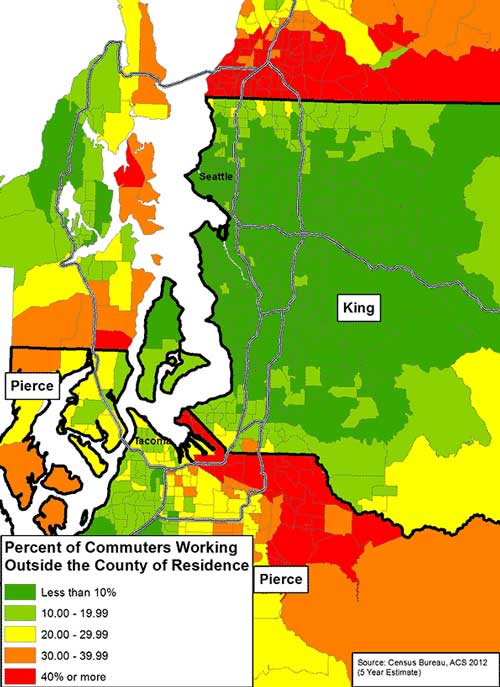 Right now Tacoma is marginally more affordable than Seattle, but income levels are not keeping pace as housing prices continue to rise, driven at least in part by Seattle workers wiling to commute in exchange for more affordable housing.
Tacomans, on the other hand, with a median family income $20,000 less than Seattle, may find it difficult to keep up.
Tacoma needs to understand its place in this regional dynamic, and make a conscious choice, as Modarres lays it out: either we accept a role as bedroom community and second city to Seattle, or we go the other way, seeing Tacoma as its own urban center.
If we choose the second option, he says, a strong coordination between housing and economic development will be necessary to reduce the mismatch between housing and employment. To restore the job-housing balance necessary to make living in Tacoma affordable for Tacomans into the future, housing must be built to accomodate the reality of median income levels, and economic development should focus on bringing in jobs that raise that median.
Finding this balance will take coordination, focus, and carefully considered decision-making.
We heard a lot about affordable housing and displacement in recent conversations surrounding the Hilltop Subarea Plan, and the word gentrification gets thrown around from time-to-time, but conversations about housing are seldom as pragmatic as this.
At last week's City Council meeting Councilmember Walker made reference to including considerations of affordable housing and prevention of displacement in not only the Hilltop Subarea Plan, but the broader citywide planning documents, including the Comprehensive Plan and upcoming citywide visioning conversations. If that's true, we may get a chance to hear about some of Modarres' ideas sooner than we thought. We hope so. What do you think?
Read Modarres' article for yourself, complete with plenty of numbers and charts, from New Geography. Do you buy his argument? If we go with the premise, can Tacoma coordinate housing and economic development efforts to achieve a balance?
Filed under: Tacoma, Economic Development, Soapbox
8 comments
E Erik B May 21, 2014
J JDHasty May 21, 2014
J Jesse May 21, 2014
C Cam May 29, 2014
S SS May 22, 2014
X Xeno May 22, 2014
N nwcolorist May 22, 2014
R RHTCCComedyfan May 22, 2014