Jobs and Housing: Finding the Sweet Spot for Affordable Quality of Life
At the UWT Urban Studies forum on jobs and housing last month we got deeper insights from panels of smart people about finding the right mix of jobs and housing for strong economic development. While the discussion looked more broadly at questions of jobs and housing trends around the country, we also got to hear the ideas applied to Tacoma and the Puget Sound Region.
Presentation slides from two of the presenters in that conversation - keynote speaker Joel Kotkin, and Urban Studies Director Ali Modarres - are now available online for the public on the Urban Studies website, along with a much more in-depth report from Modarres, with analyses of the maps and charts in his presentation - definitely worth reading if you want a better understanding of some of the dynamics at play in our region. The Urban Studies department also live-tweeted the event, and a look back at their timeline captures some moments and statements from the day (scroll back to February 19).
The speakers were more eloquent than we can possibly be on the topic, but we'll try to point out a few themes that emerged when it came to the Puget Sound Region, and Tacoma's place in it.
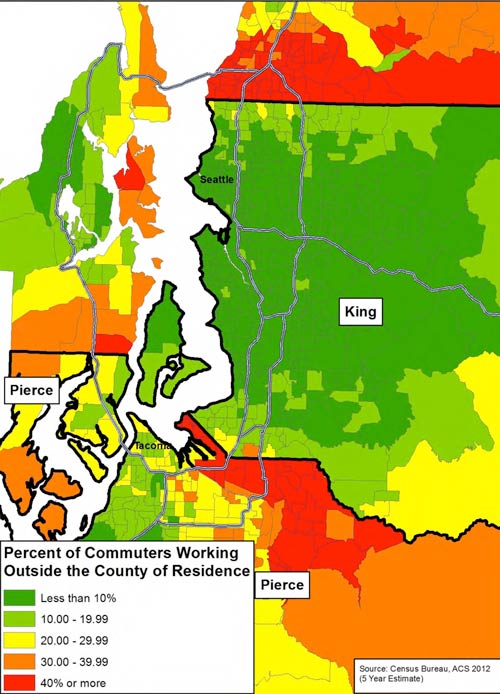
There's no getting around the fact that Seattle dominates the economy in the region, and possibly in the state. If you had any doubt about that, a look at Modarres' maps and charts is pretty convincing - Seattle has more jobs, more companies, higher incomes, higher educational attainment, and higher wages - even within some of the same categories of jobs. Homes are worth more in Seattle, and the percentage of workers commuting to jobs outside King County is tiny, compared to the much larger numbers of Pierce County residents commuting outside our county (see above map).
So Seattle has all that. What do Tacoma and Pierce County have? Well, we have affordability, and we have the smaller towns and less dense conditions that may actually be what people are looking for.
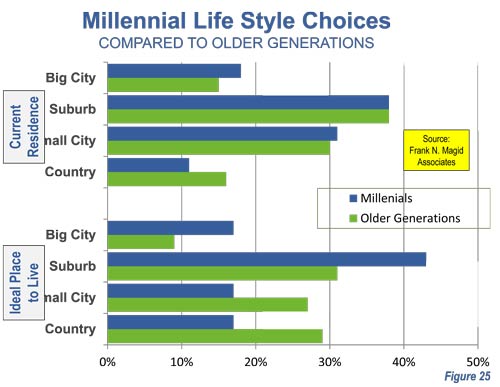
We frequently hear that millenials find dense urban centers more attractive than previous generations, and will seek them out. Some of the statistics we saw at the forum suggest that while more of that generation may be open to living in the more dense big city, they also like the suburbs. Lunchtime keynote speaker Kotkin noted that across the country people are heading for smaller towns and cities, leaving urban cores, looking for affordability. Kotkin cited statistics suggesting that Americans, even Millenials, want single-family homes in suburban environments - particularly earlier suburban areas.
Tacoma and Pierce County can offer that.
But they also want access to good jobs, good schools, and good amenities. That's an area of... opportunity for Tacoma, if the city is to attract growth.
Tacoma's universities are another asset for Pierce County. Universities, Modarres noted, are a strong source of growth, people, and jobs. They bring and train the "creative class," and act as economic engines. But if the people who come to a city for reasons related to a university don't have attractive housing options - supported by the schools, neighborhoods, and other amenities they want - they will leave, Modarres warned. As we see with the outflow of workers from Pierce County to King County.
If regions don’t figure out how to work with their universities, their universities will become an engine for exporting their skilled workforce.
To keep people who are already here, and to attract others, then, Tacoma and Pierce County need a unified vision for growth. We heard several themes throughout the forum in terms of key elements of a strong and sustainable economic development strategy for the region.
- Focus on our strengths - we heard from several speakers that the region needs to focus on its existing strengths, rather than trying to ape other cities' successes.
- Focus on growing and diversifying higher wage industries - the region has long focused on middle class needs, but there is an area of opportunity for attracting higher wage workers who don't want to be in urban cores
- Prepare for and actively seek out populations expected to see significant growth in the coming decades: the "young old," or active retired baby boomers; millenials and young families; and immigrant populations
- Market the region as a great place for people seeking affordable quality of life.
In response to an audience question following up on his presentation, keynote speaker Kotkin responded that the "sweet spot" for cities is to provide attractive housing near jobs, amenities, and good schools. The trick, Kotkin said, is to provide that situation, but make it affordable. Tacoma and Pierce County could hit this sweet spot, but it will take a concerted effort.
That's some of what we heard at the forum - there was a lot more - what did you hear? What do you think?
Find supporting documents from the forum on the Urban Studies resources page (under "Community Resources" on the sidebar).
Update: Video of the forum, including keynote speaker Kotkin, and opening and closing remarks by Dr. Modarres.
Urban Studies 2015 Closing Modarres
Urban Studies 2015 Keynote Kotkin
Urban Studies 2015 Opening Modarres
Urban Studies 2015 Panel 1 Seltzer Sims Bozeman Boe
Filed under: UWT, Events, Colleges & Universities, Economic Development
4 comments
A Andrew March 6, 2015
T Terry March 7, 2015
A Andrew March 10, 2015
J James March 6, 2015