Landscaping Code Changes Proposed to Increase Tree Canopy
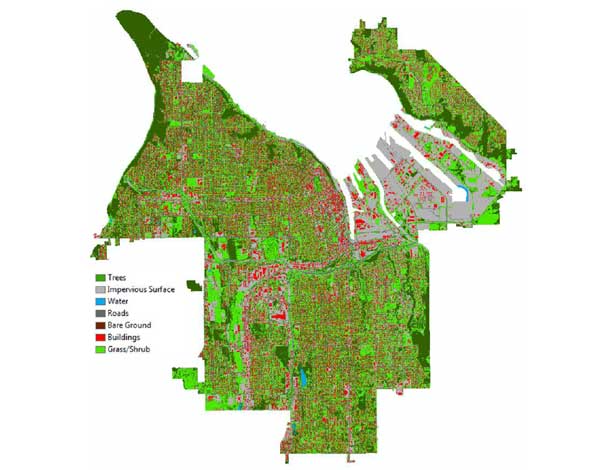
By the year 2030 Tacoma will look a little greener. That’s according to the Urban Forest Policy Element of Tacoma’s Comprehensive Plan.
Adopted in 2010, the Urban Forest Policy sets a goal of improving the health and function of Tacoma’s urban forest, and reaching 30% tree canopy coverage by 2030. That would be an increase from the current 19% coverage found by a 2011 study.
As a part of work towards reaching the “30 by 30” target, changes are being proposed to the city’s landscaping code to bring it into alignment with the Urban Forest Policy Element of Tacoma’s Comprehensive Plan. City Council was briefed on the policy and the proposed code changes at the April 19 study session.
Proposed code changes are designed to encourage increases in the canopy cover through changes to requirements for rights-of-way, parking lots, and sites including institutions, parks, and one, two, and three-family dwellings. More details are available in the Summary of Key Changes, available along with other information at the City of Tacoma 2012 Urban Forestry Landscaping Code Update page.
According to the project information, these code changes are supplemented by other efforts.
Though the focus is on code, the project is best understood within the context of related efforts currently underway. Staff from the Urban Forestry Program are working on a variety of fronts to achieve urban forest goals. Key ongoing efforts include the following: City projects; incentives and assistance; education and outreach; technical guidance; and, review of regulatory approaches.
According to materials presented to the Council, urban canopy coverage is beneficial for a number of reasons, including links with improvements in “oxygen production, air temperature reduction, air and water quality benefits, greenhouse gas reduction, wildlife habitat, noise reduction, building energy conservation, prolonged infrastructure life, and sociological/physiological and aesthetic benefits.”
There will be a Planning Commission public hearing May 2. The Commission will then review public comments, and is expected to make recommendations to City Council on June 6.
If you were a tree, what kind of tree would you be?
Filed under: comprehensive-plan, urban-forestry
42 comments
P Peter Peter April 26, 2012
I don’t think I ever realized how square Ruston is.
T tacoma_1 April 26, 2012
What kind of tree would I be?
A Tsuga Mertensiana is what I’d be
(mtn hemlock)
F fredo April 26, 2012
If the city wants more trees in the right of ways then it needs to embrace an ongoing sidewalk, side sewer and curb replacement program. The street trees destroy everything in their path. The damages endanger everybody from elderly pedestrians to bicyclists.
J jd April 26, 2012
“The street trees endanger everything in their path”?
Jeesh, you make it sound more like molten lava than environmentally beneficial, pretty, green shade trees. By the way, there are species of trees that don’t have invasive root systems, don’t rain toxic waste down on unsuspecting pedestrians, and aren’t Satan worshippers.
J Jesse April 26, 2012
@fredo: The wrong type of trees destroy everything in their paths. You know you can plant a tree that primarily seeks water below itself with it’s roots as opposed to roots crawling along the surface — doing things like destroying sidewalks.
Also, the best neighborhoods have exceptional tree canopies or views. You can’t have view homes everywhere so trees drastically improve neighborhood beauty and therefore increase property values.
When will they do plantings along I-5? How about 38th and I-5? Dig up planter strips filled with asphalt along Pacific Avenue and South Tacoma Way?
T tacoma_1 April 26, 2012
I think fredo would be a crabb apple tree,
F fredo April 26, 2012
Let’s not be so naive.
There are arborial horror stories all over Tacoma and the sum total of destroyed sidewalks and curbs is certainly in the many millions of dollars. What is in short supply is the johnny appleseeds who are willing to come out and repair this tree related damage. they’re hot to trot when it comes to advocating for a “canopy” but avoid like the plague any acquaintance with the aftermath.
If you are going to put a tree in my right of way then you should also put a sum of money in an escrow account to pay for damages which may not occur for another 30 or 40 years.
C Christine April 26, 2012
I have to agree with fredo’s remark on this one. Over the decades I’ve lived in Tacoma I have seen the absolutely wrong tree planted in the wrong place over and over. A prime example is the maples along Ruston Way. (Disclaimer: I am not an arborist, I think that they are Maples). These trees which are known for extensive ground-level root and also can grow to be an easy 3 or 4 feet in diameter are planted in a grass strip measuring about 3 feet from curb to sidewalk.
And if the hatchet job that was done to a cedar near our house is an example of the city arborists, please spend the money to hire someone that has a clue.
There are right plant, right place books available and there are profession arborists in the area that could direct the city in which trees to plant where.
S subterranean April 26, 2012
Being concerned over the maintenance and impacts from the street trees does not make one anti-tree. These issues are existing and ongoing for many people. I have had to make costly repairs to my sidewalk because my street was lined with red maples. I can walk up and down the street and wherever a maple was planted the sidewalk is lifting and cracking. The solution is in part getting better at planting the right trees and the City is making good progress on that front. But this is also a mobility problem. On the very same street where new curb ramps have been installed, there are sidewalk segments that are probably impassable for a wheel chair and while this is public property the individual homeowners are held responsible for the financial burden as well as the liability, which means repairs almost never get done until the City enforces. There really needs to be a more comprehensive solution to these issues alongside the push to expand tree canopy. But don’t think for a second that having these concerns makes someone ‘anti-tree’.
J Jesse April 26, 2012
I’d rather have big beautiful trees lining the streets and a few sidewalk bumps than South Tacoma Way where the planter strips are all paved in.
“Let’s not be so naive” — fredo
Just because we disagree, that doesn’t give you the right to call people naive or stupid.
I am sorry the city planted a tree in front of your stores sign.
F fredo April 27, 2012
“Just because we disagree, that doesn’t give you the right to call people naive or stupid.”
I didn’t call anbody stupid.
If the city wants people to everyone to embrace the canopy idea then it is going to have to take a serious look at addressing tree related infrastructural damage. People who can’t accept that something as beautiful as a tree can create wildly expensive hazards in an urban environment are being naive IMO.
S Stereo Boy April 27, 2012
Three things the city could do to truly be “tree friendly”:
1) put powerlines underground (no more butcher pruning jobs and downed power
2) install rubber, pourous, sidewalks instead of asphalt
3) prevent Clear Channel from any permission to cut trees near their billboards.
.
A AreteTacoma April 27, 2012
And properly selected street trees can be a part of good roads, in my opinion.
M Mofo from the Hood April 27, 2012
Something must be done to stop the radio signals emitting from Fircrest’s Ministry of Urban Canopy.*
George Orwell warned us about this kind of stuff:
“According to materials presented to the Council, urban canopy coverage is beneficial for a number of reasons, including links with improvements in “oxygen production, air temperature reduction, air and water quality benefits, greenhouse gas reduction, wildlife habitat, noise reduction, building energy conservation, prolonged infrastructure life, and sociological/physiological and aesthetic benefits.”
*Urban Canopy: 1: Woody perennial plants—usu. used in pl. 2: Tree’s
S Stereo Boy April 27, 2012
Arete, and others, I disagree with the mantra of “properly selected” trees. Introducing non-native species (because they “fit” into the artificially designed landscape) will only bring additional problems. If tall trees are native to the area and support urban wildlife, then we should have those tall trees. With the amount of rainfall for this area, many trees don’t need to be deep water-seekers and we should adjust sidewalks to the those native trees, not vice versa.
F fredo April 27, 2012
I’m not anti-tree or anti-canopy. While it is true that the right tree in the right place makes for a nicely landscaped city, in fact, all too often the wrong trees are going into the wrong places.
All I’m advocating is that that tree canopy advocates proclaim that maintenance of infrastructure is a key component of all planting decisions. If we want smooth streets, smooth curbs and smooth sidewalks as well as a canopy, then these initiatives should be joined.
F fredo April 27, 2012
Looking at the map I couldn’t help but notice that the port of Tacoma is really not doing a very good job with providing a tree canopy. If we are going to continue to support the port with our tax dollars then we should expect these folks to begin planting a forest in these cargo and industrial sites.
J jd April 27, 2012
Fredo’s absolutely right about the Port. They’re buying up all the land they can, scraping it bare, and covering it with concrete. We’re supporting them with our taxes, yet they don’t appear to be held to the same standards as the rest of us. I realize that it’s comparing apples and oranges, but maybe they should be required to set aside other land (in Tacoma) as green space.
Another thing that I agree with Fredo about (!!) is the need to require proper selection, planning, and maintenance as part of the process. If we haphazardly plunk more trees into the ground, and then maintain them poorly, we haven’t really accomplished anything constructive.
Having said that, I’d rather live here with our wavy sidewalks, than live in Tucson, Phoenix, etc.!
F fredo April 27, 2012
“I’d rather live here with our wavy sidewalks” jd
I’m going to guess that you are a young person and are fully ambulatory. If you were an elderly person with vision or mobility problems or were handicapped and had to navigate the broken sidewalks with a walker or wheelchair I’m guessing you would have a less cavalier attitude about the condition of the walks.
Still, it’s nice to have a some areas of agreement with you jd.
T tacoma_1 April 27, 2012
Pretty sure that city code makes the home owner responsible for damage to the sidewalk next to the home. It just needs to be enforced better, IMHO.
F fredo April 27, 2012
Well, that existing city code will be a good way to turn lots of home owners against the canopy initiative. How about we re structure the city code along these lines:
If the homeowner or his tenant puts in a tree and it causes damages then he pays for it.
If the city puts in a tree and it causes damages then the city pays for it.
I’m OK with that.
T tacoma_1 April 27, 2012
okey dokey
btw, for every dumb ass that plants a big leaf maple or a sequoia next to the sidewalk, there is a bigger dumb ass that cuts down perfectly suitable street trees just so they can park their car on the city row.
T tacoma_1 April 27, 2012
row = right of way, i.e. parking strip
F fredo April 27, 2012
agree with much you say tacoma 1.
I’m not sure that when you see a “perfectly suitable street tree” cut down it was removed necessarily to create a parking place. It’s possible the tree was growing into the side sewer or was causing some other problem that was not observable by you. Let’s give property owners the benefit of the doubt. It’s sad to see a nice tree come down but this is a renewable resource. You can bring home a sapling from Watsons nursery, plant it in a good location and in 20 years you will have a specimen tree. I know, I’ve done it.
A AreteTacoma April 27, 2012
That map is very interesting to look at. It’ll be pretty tough to get to 30% coverage unless the massive baren areas at the port are excluded. Also, does anyone know the story behind that little island of Tacoma that is completly surrounded by Fircrest?
J jd April 28, 2012
Fredo has come up with the perfect Reader’s Digest version of this issue…you break it, you fix it. And in the mean time, you have to take care of it!
J JJ May 1, 2012
Because of expected governmental,societal and drastic economic upheaval due to the loss of fossil fuels in the very near future food will have to be produced locally a must really for residents to survive after the absence of petroleum based products and fuels.Also the Natural Gas used in the Haber-Bosch process to make synthetic fertilizers will be unavailable for food production hence mass worldwide starvation.Food will have to be produced locally using organic farming methods.
Therefore I recommend Fruit trees (Apples,Cherry,Pear,Plum,Nut trees etc) ideal for this region because they will produce food locally for the remaining surviving populace which will be absolutely needed during expected food shortages.Food shortages will become so dire that pests of these trees like raccoons and rodents might even be eaten by the mass starving yet surviving populace.
A Altered Chords May 2, 2012
The city has already begun planting baobab, weeping willows and sequoia trees everywhere. These entish monsters will devour every last bit of concrete and asphalt in this nasty little town.
If you don’t like trees, move to arizona.
T tacoma_1 May 2, 2012
“entish monsters”
I like it!
F fredo May 2, 2012
They say the devil is in the details. And here we can see this is true.
The new canopy guidelines require a 30% canopy cover in all residential ROWs. I think this means homeowners will have to have trees in their ROW. Furthermore, decisions regarding maintenance or pruning must be reviewed by a certified arborist. If the tree placed in front of the residence breaks into the sidewalk, the curbing or the side sewer, that’s on the homeowner too.
This all sounds benign, but the reality is these new requirements are going to cost homeowners a fortune and are going to be cumbersome to administer. We’re talking about hundreds of thousands of trees which will have their pruning records maintained to show that every single branch cut was authorized by an arborist. This is taking Tacomas New Utopianism too far.
On the commercial side, the new requirements will force folks with parking lots to rip up a lot of parking and put in trees. This will be expensive and will give would be developers one more reason not to locate in Tacoma. The council is doing everything possible to thwart new business and that seems like the only thing they are truly good at.
T talus May 2, 2012
“Guidelines,” by definition, don’t “require” anything. 30% is just a goal.
A Altered-Chords May 2, 2012
Fredo – this is a business opportunity. Altered Chords tree pruning/ sidewald tree damage remediation. Sales will be slow to start but 30 years from now when I’d dead and gone, my kids will be making $$ hand over fist repairing sidewalks and strategically snipping tree limbs.
F fredo May 2, 2012
The 30% is a goal. But the city wants to enact Code Changes in an effort to achieve the goal. “Code changes” do require conformance. Property owners don’t the have the option of not participating. Please click on the link to Summary of Key Changes that Derek has provided in the story. Hope that clears things up.
F fredo May 2, 2012
These code changes really signal a sort of swan song for property rights.
Property owners will be REQUIRED to maintain what amounts to a public park in the right of way abutting their property. The code is very specific about how it’s to be planted and maintained. Irrigation must be provided so everything will look spiffy and and a huge corps of crack arborists will be available to snip every errant twig at the homeowners expense. Cracked sidewalks caused by the city love affair with tree canopies? Oh, that’s on the property owner too. Trim your own tree without permission or forget to water it? Big fine coming your way. In order to create a vegatative utopia we’re going to have to step on a few people.
Oh, and the “science” that supports this: questionable. There will be hundreds of arborists trucks and cement finishers driving all over the place creating thousands of tons of new exhaust so that we can have more trees to clean the air.
A Anon-e-mouse May 6, 2012
Why so much fuss about trees next to roads and sidewalks? Many homeowners seem to think they live in Kansas, with mostly flat lawns and no trees. Encouraging (not legislating) the planting of tall native trees in yards both gets more trees out there while reducing water-sucking lawns, and no sidewalks or roads are harmed. Plant native shrubs (flowering, preferably) next to roads and sidewalks, to reduce damage and still keep it green.
PS – as some homeowners don’t keep up their lawns/yards, trees will also improve community appearance.
F fredo May 6, 2012
Some people actually enjoy having the sun shine directly on their property. Sunshine feels good and children enjoy playing in the grass. These enviro-nuts that think every square inch of the city needs to be draped in a leafy canopy are a sorry lot. I’d prefer to landsape my property in the manner that appeals to me. Grass and other small shrubs provide many of the same benefits as the sidewalk cracking trees at a much lower expense.
T tacoma_1 May 6, 2012
A “good“street tree will not have a root system that damages sidewalks. It will also have a straight trunk without branches at the lower 5 feet or so. That is so car drivers can see around (thru) them for pedestrian safety and so ne’er-do-wells can’t use them to hide in or hide their stuff in.
Not many native trees fit that bill. Certainly not any ornamental trees.
F fredo May 7, 2012
Find me the name of a “good street tree” and I’ll see if I can find a picture of a sidewalk damaged by this variety of tree.
T tacoma_1 May 7, 2012
Malus floribunda.
J Jenny Jenkins May 7, 2012
Ooh, that’s a pretty one. I’d love to have a couple of those in front of my house!
F fredo May 7, 2012
Malus Floribunda
Couldn’t find much information about concrete cracking characteristics, but here is some information regarding suitability as a street tree:
1. When used as a “street tree” they need to be trained in order to achieve a central trunk.
2. The natural shape of the plant is to have wide droopy branches (up to 25 feet diameter)
3. They drop a lot of fruit and make pedestrian walkways messy.
4. Plant only in areas where they don’t overhang the walkways.
5. Attractive to mammals.
This information was presented by Edward F Giman and I found it by googling the topic.
T tacoma_1 May 7, 2012
Fredo
The specific hybrid that I have is essentially non fruiting (the fruit is miniscule, and the birds eat what little there is) and it also has a straight trunk. And of course, as requested, no sidewalk damage either.
If ya don’t like dat one, try Acer griseum.