Mixing Up Tacoma's Mixed-Use Centers
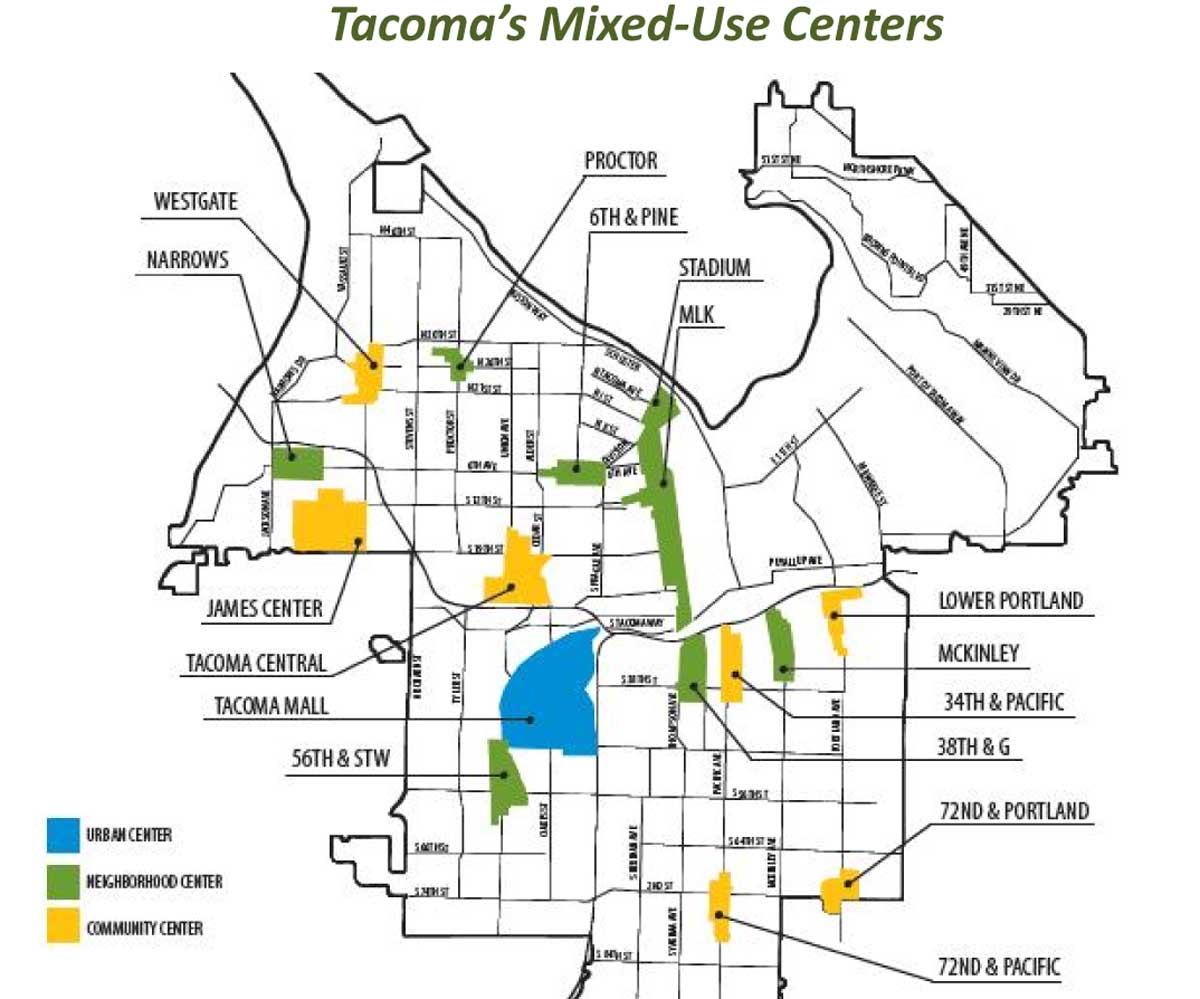
The City of Tacoma is revisiting its plan for its mixed-use centers. We heard the beginning of the discussion at last week’s Committee of the Whole meeting.
The conversation comes in part out of the impending Comprehensive Plan review that needs to be done by 2015. More pressing for Tacoma’s 17 mixed-use centers, however, is the question of whether they’re helping the City accomplish what it set out to do when it created them.
Mixed-use centers have been at the heart of City plans for growth and development since it was required by the Growth Management Act to identify growth centers in the 1990s. The goal for 17 MUCs identified in Tacoma’s Comprehensive Plan is to renew and transform those areas into functional, vibrant, sustainable “urban villages” with a compact, complete and connected mix of shops, services, and public spaces. In practical terms this means mixed-use developments, multi-family housing, pedestrian-oriented streets, and a move away from automobile dependent development.
The problem is that it hasn’t necessarily worked. The mixed-use centers, and the plans that center around encouraging their development, were created before the economy took a downturn and developers stopped developing much of anything - especially multi-story projects with limited parking and retail space for which there is little demand.
So the City will be reviewing all of its mixed-use centers, from the (relatively) successful ones like Proctor and 6th and Pine to those that have seen little or no development consistent with what the designation envisions. Through that process it will also be reviewing the hierarchy by which MUCs are divided into downtown, urban, community, and neighborhood subtypes. The City will also take a look at the various tax and other incentives designed to encourage high density development of the sort that would earn the “urban village” name.
This will be a comprehensive conversation about what it means to be a Mixed-Use Center, and whether all 17 still make sense - whether in the current format, or any format at all. Parts of the code that don’t work will be re-worked or dropped. Unsuccessful MUCs will either see changes or may be dropped from the MUC list.
Having 17 of these centers on a citywide scale may make City officials feel like their attention is spread too thin, but if you live in or near one of these centers, does it feel that way to you? Are these centers of greater importance in the big picture planning of a city or are they most meaningful at the neighborhood level - to the residents and businesses in the little “urban villages?” Or are they important at all?
Filed under: Neighborhoods, City Government, Comprehensive Plan, Strategic Planning
5 comments
J Jesse July 24, 2013
T tacoma1 July 24, 2013
F fred davie July 24, 2013
S Sid July 25, 2013
J John March 3, 2014