More Housing Variety, More Affordable Housing
A set of proposals aimed at increasing the amount of affordable housing and housing choice available in Tacoma has been making its way through the planning process, and is now ready for public comment.
Most of Tacoma’s residential land is zoned for single family homes, limiting the density and amount of housing available. This is part of a broader residential zoning code framework that has been in place in Tacoma since 1953. A major driving force behind that original code was the elimination of “messiness” of uses. It’s been more than half a century, and with Tacoma looking at a mandate to accommodate significant growth in the coming decades, it seems like it may be time to revisit the code, particularly as it applies to issues of density and affordability.
The proposals currently on the table for inclusion in the 2015 amendment to the comprehensive plan and land use code were initiated by Tacoma's Affordable Housing Policy Advisory Group. They include both a broadening of housing types available in the city's residentially zoned neighborhoods, and more general incentives to encourage the inclusion of affordable housing options in new development. The new proposals are meant to function as a part of the broader spectrum of affordable housing policies and strategies in Tacoma, which includes a range of subsidized housing, housing maintenance and rehabilitation, economic development, and other strategies.
The proposed changes for 2015 fall generally into two categories; infill housing strategies, or affordable housing incentives/requirements.
The infill housing strategies don't directly or necessarily result in affordable housing, but the thought is that they may de facto lead to greater availability by lowering land and infrastructure costs, decreasing housing unit size, and increasing the diversity of housing choices available in all neighborhoods, and at all price levels.
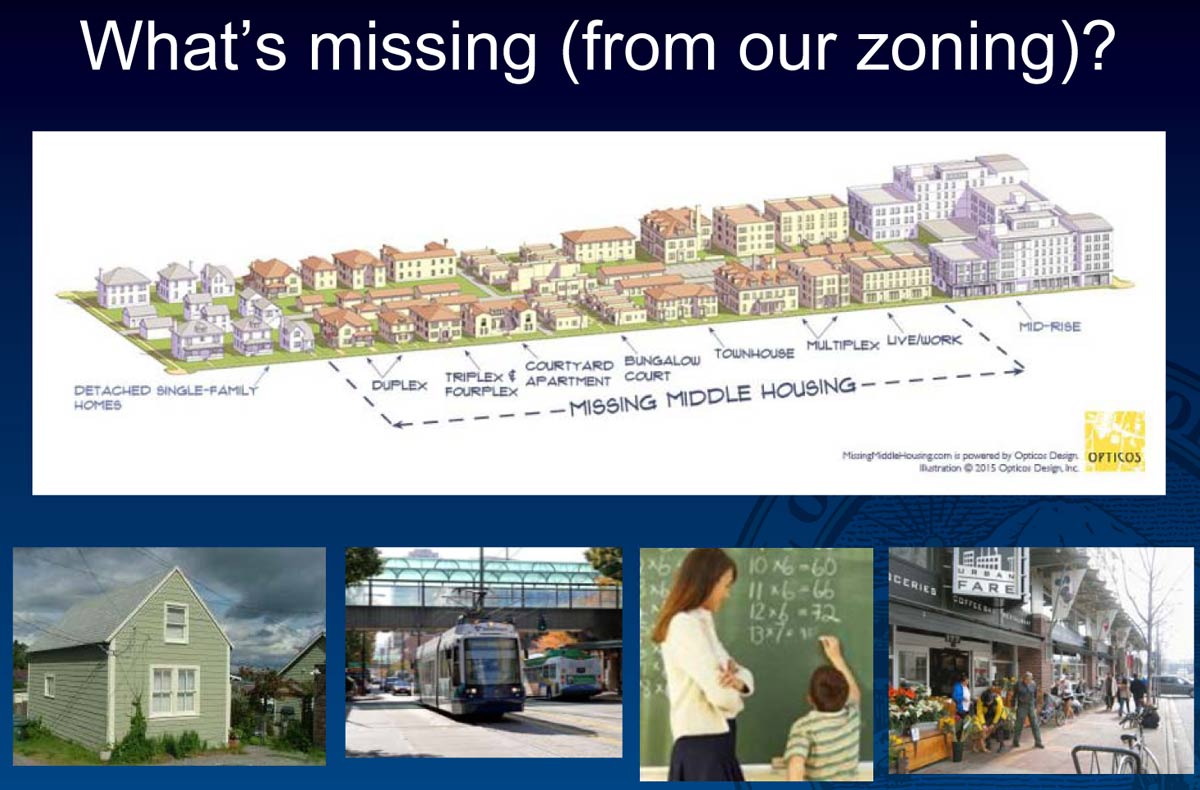
A lot of these changes are aimed at making room in Tacoma's land use code for what is sometimes referred to as "the missing middle" (see the above image, taken from the August 3, 2015 City Council study session). That's a reference to code that allows for single-family detached housing, and multi-family high rises, but makes it much more difficult, if not downright impossible to build the in-between options like duplexes, triplexes, townhomes, and other more creative arrangements. This means missed opportunities for density and infill development, as well as a gap in available housing for those who can't or don't want to fit into the two extremes of single-family homes or high rise apartments. Some of these changes seek to change this.
- Lot size flexibility - The proposal refers to this as "context-responsive infill." In 2008 changes were made allowing for the construction of homes on lots that are smaller than what is generally allowed in residential neighborhoods to encourage infill development. The new proposal would allow further reductions to a minimum lot size of 3,000 square feet through a lot size averaging approach. In exchange for that smaller lot size, however, the City would have greater discretion over what is built on it. Homes would be limited in size as a ratio of the lot size, and stricter design standards would be applied to support that "context-responsive" goal. This new rule would apply across all residential districts.
- Special review districts refinements - These would be changes to the special category previously created for neighborhoods that predate that 1950s code, and could not be rebuilt as they are - primarily a mix of different residential types - under today's rules. The proposed changes are intended to promote a development pattern that continues to be predominately single-family residential, with flexibility built in to allow for smaller lot sizes and a mix of other housing types. Changes include a reduction in the minimum lot size, enhanced small lot design standards, and updated conditional criteria to allow for 2- and 3-family structures where consistent with neighborhood and historic district character.
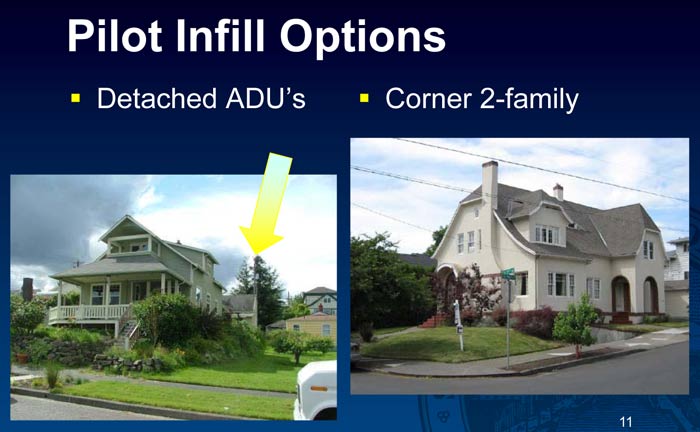
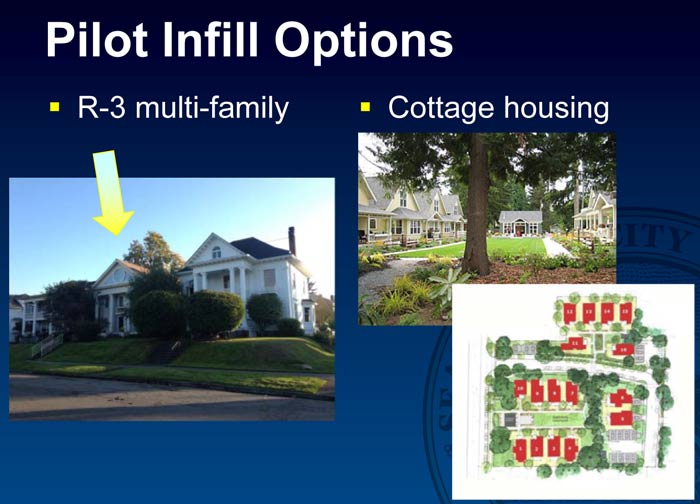
- Pilot residential infill program - This would allow for a variety of innovative housing types in residential districts with an enhanced discretionary review by the City during a test phase. At the end of the pilot project, it would be reviewed, and approaches refined as needed. The pilot would include infill housing, including detached accessory dwelling units in R-2 and historic districts, two-family development as a conditional use on corner lots in R-2 districts, multi-family as a conditional use in R-3 districts, and cottage housing developments as a conditional use in all residential districts.
- Planned residential districts - Current code allows for the construction of these, but it is undertilized, due in part to the lack of vast tracts of land in Tacoma, and partly due to lack of sufficient flexibility in the code to make it an attractive option for developers. The planned changes would update the code to make PRDs a more effective tool for site development. Optional density bonuses would be added to incentivize affordability and sustainability, and minimum site size and common open space requirements would be reduced for this category of development to increase opportunities for use of this approach, and design requirements would emphasize urban design, complete streets, and connections to surrounding streets and paths.
Alongside these more flexible infill strategies, the affordable housing incentives more explicitly address affordable housing availability. They offer height, density, or other bonuses to incentivize the inclusion of affordable housing in new development, and require it in cases of residential upzones. The idea is to make the construction of affordable housing more attractive and cost-effective for developers. These incentives seek to increase the stock of housing affordable to households with incomes considered "moderately low" - between 50% and 80% of the Area Median Income. The incentives are voluntary; the requirement of affordable housing associated with residential upzone requests would not be.
- Affordable housing incentives & upzone requirements: These changes would make density bonuses and permit fee reductions available to developers in exchange for voluntary inclusion of affordable housing. Requests for residential upzones would also come with a requirement that the requesting developer include affordable housing in the project or pay a fee-in-lieu. Additional incentives would include a downtown Tacoma floor area ratio bonus and a planned residential district density bonus for inclusion of affordable housing.
- City process enhancements: Although not directly tied to code amendments, these are areas where the City can facilitate the development of affordable housing by lowering costs and delays. One area would be the authorization of fee reductions and permit process enhancements, pending resource availability. Another area would be the development of a library of examples of desireable residential infill housing projects to illustrate what the City is looking for.
So there you have it, proposed affordable housing amendments for 2015. You can view this and other elements of the 2015 Annual Amendment on the City of Tacoma's Planning Department page, and learn more at a pair of upcoming info sessions, followed by a Planning Commission public hearing for all the proposed amendments. If you can't make that, but still have opinions about any or all of the proposed amendments, you can share them with the City in writing until 5 p.m. on Friday, August 28.
What's your opinion? Do these seem like workable proposals?
Community Informational Session 1
Wednesday, August 12, 2015
6 PM - 8 PM
Baker Middle School
Community Informational Session 2
Thursday, August 13, 2015
6 PM - 8 PM
Stadium High School
Planning Commission Public Hearing
Wednesday, August 19, 2015
5 PM
Tacoma Municipal Building
Filed under: Neighborhoods, City Government, Comprehensive Plan, Affordable Housing
17 comments
J Jesse August 6, 2015
J JDHasty August 7, 2015
X Xeno August 7, 2015
J JDHasty August 7, 2015
A ApitbullnamedPlug August 8, 2015
J Jesse August 7, 2015
A Aaron August 7, 2015
J JDHasty August 7, 2015
A Aaron August 9, 2015
J JDHasty August 7, 2015
J Jerry Ramsey August 7, 2015
J Jim C August 7, 2015
S sid August 7, 2015
R RHTCCComedyfan August 8, 2015
D Dave August 8, 2015
J JDHasty August 9, 2015
T tina August 13, 2015