Op-Ed: Don’t Suburban-ize Tacoma
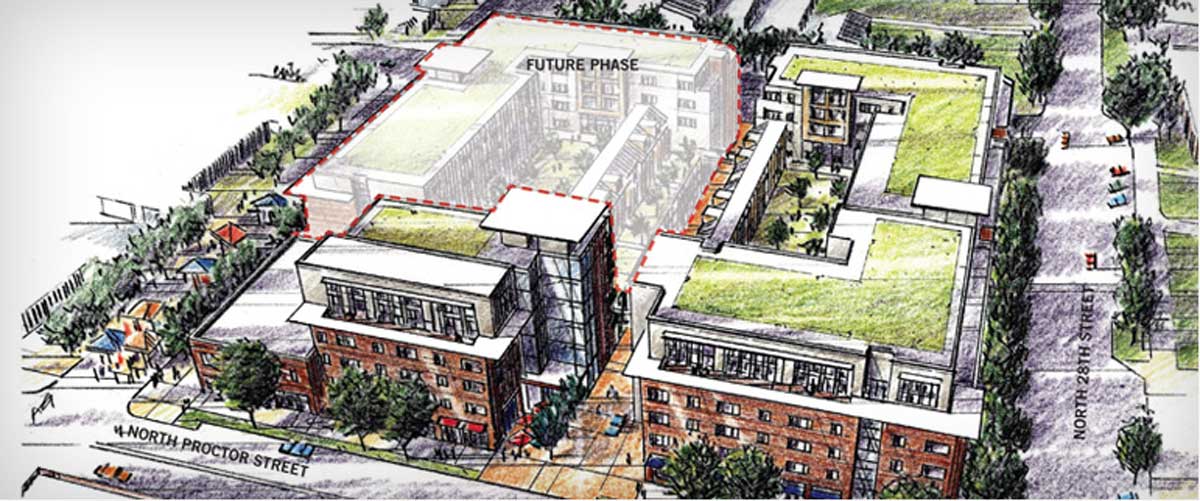
Conversations about growth, density, and affordability have dominated our happy hour conversations lately. It may be the friends we hang out with, or it could be that Tacoma has some long-awaited for momentum and is approaching a crossroads. What is the future of Tacoma? - Derek
Bill Virgin’s recent article (“Is Tacoma taking Seattle-like growth tactics too far?”, June 4, 2016) in the Tacoma News Tribune represents the latest chapter in the ongoing community dialogue about the character of development patterns emerging during the economic recovery. Finally, after over a decade of planning for growth and development in the city’s neighborhood business districts, Tacoma is finally seeing new density in areas designated for the centralization of growth, which has been the centerpiece of the city’s growth strategy for years. This policy is meant to encourage the clustering of development and population growth in areas designated to receive new residents, retail shopping, and jobs and professional services. This policy is intended to capture 80% of the city’s anticipated population growth, for which Tacoma has planned to receive 127,000 additional people by 2040. The purpose of this policy is to protect single-family neighborhoods city-wide while placing new residents in close proximity to jobs, services, and transit, thereby reducing the dependence upon using single-occupancy automobile modes for daily needs and commuting.
So while the cleverly-coined phase ‘Don’t Seattle-ize Tacoma’ may be the cry of resistance, the imminent population growth set to occur over the next 25 years in one of the largest urban cities in the Pacific Northwest begs for a wholly different catch-phrase – ‘Don’t suburban-ize Tacoma’.
Despite the well-thought-out development strategy of centralizing growth, Mr. Virgin offers the banal response we’ve all heard before, without offering up a single new thought or alternative. If you missed the column, he advocates for resisting urban scale, mid-rise development in the city’s most urban centers where transit, shopping and professional services located near housing will reduce traffic congestion, protect natural resource lands in rural areas of Pierce County, reinvigorate civic and social life, and add to the character of Tacoma as a progressive community. What Mr. Virgin doesn’t realize or decided not to share in his column is that creating a ceiling on housing in the city will only drive prices up, as well as force people to move further and further away from the I-5 corridor in search of affordability. This will not only exacerbate traffic congestion as commuters travel on low-capacity roads without access to transit infrastructure, but also result in the conversion of farms, forests, and other critical open space for subdivisions.
Locating development near transit lines and in walkable communities reduces our collective need for the automobile and creates a place that’s focused on people--all people--and creates a place we all want to be. Pierce Transit has been thoughtful about efficiencies in their system and forward-thinking about planning for the future. Our regional transit provider, Sound Transit, has put together an ambitious package of investments that provide regional connections for employees who need to commute to the north and south, as well as investing in our local Link service.
If we want to grow economically, planning around transportation is vital. Businesses know that employees are asking for choices, not highways. For example, by encouraging development in our downtown, with great options for transit and great walkability (downtown Tacoma boosts a Walk Score of 93 – www.walkscore.com), we support housing and transportation options, community building, and safety, while creating an environment that supports business development.
When we grow right, we can continue to make our communities attractive places to live and work. But if the region grows as it did in recent decades, people will lose access to services, farms, forests and open spaces will continue to be converted for seemingly-endless subdivisions, and roads and public infrastructure will be increasingly burdened by use that they were never intended to accommodate. This type of growth where we continue to build out into our rural areas will equate to less access to local agricultural products, increased air and water pollution, and more time spent in cars getting from place to place. Think about it: would you prefer to spend all of your time in a car rather than at home with your family, socializing with friends, or enjoying our world-renowned parks and open space? If your answer is “no,” then you too know that can grow in a way that doesn’t jeopardize our community and way of life.
Planning for growth doesn't have to mean bland monoliths that strip a neighborhood of its character. In fact, if done right, these developments can add amenities, attract more visitors to shops and restaurants, and aesthetically fit into the exiting neighborhood, often times replacing disinvested eyesores. These new homes and services will also be connected by transit service, walking, and biking infrastructure that connect people to worksites and mitigating many traffic concerns.
So let’s grow right so that new development builds on the character of our existing communities rather than supplants them, that people can find ways to get to and from work quickly so that they don’t sit in traffic while their children wait for them to come home, and so that future generations can continue to pick their Halloween pumpkins in the Puyallup Valley. The alternative jeopardizes the very quality of life that we cherish.
AUTHORS
Jordan Rash - Forterra
Chris Beale, AICP, Chair – Tacoma Planning Commission
Kristina Walker - Downtown On the Go!
54 comments
L LB June 15, 2016
J Jesse June 15, 2016
T Terry June 15, 2016
A Alicia June 16, 2016
D Donde Groovily June 21, 2016
T terry June 22, 2016
T Tim Smith June 22, 2016
D David Boe June 16, 2016
D David Web December 2, 2016
C Chris June 16, 2016
D Diogenes Xenos July 11, 2016
R RHTCCComedyfan June 16, 2016
R RHTCCComedyfan June 16, 2016
D DeeBee Cooper June 16, 2016
T talus June 16, 2016
J Jacob Berkey June 19, 2016
B Brendan June 19, 2016
D Diogenes Xenos July 11, 2016
B Brendan July 12, 2016
J JDHasty June 20, 2016
T Terry June 20, 2016
D Donde Groovily June 21, 2016
J JDHasty June 22, 2016
D Diogenes Xenos July 11, 2016
J JDHasty July 13, 2016
J Joe-Nate June 21, 2016
T Tim Smith June 21, 2016
T Terry June 21, 2016
T Tim Smith June 22, 2016
T Terry June 22, 2016
T Tim Smith June 22, 2016
T Tim Smith June 22, 2016
R RHTCCComedyfan June 22, 2016
J Jesse June 21, 2016
J JDHasty June 28, 2016
B BiblicalProduct June 28, 2016
R RHTCCComedyfan June 29, 2016
S Stephen July 11, 2016
J joe-nate June 29, 2016
P Phillip June 30, 2016
B Brendan July 2, 2016
J JDHasty July 6, 2016
T talus July 7, 2016
R RHTCCComedyfan July 8, 2016
D D. Hansen July 12, 2016
R RHTCCComedyfan July 13, 2016
D D. Hansen July 13, 2016
X xxx July 24, 2016
T talus July 25, 2016
B BG July 25, 2016
S Smarter Growth August 7, 2016
E Engineer September 14, 2016
D Dave December 3, 2016
A Alex Boone April 12, 2017