Renoir as Printmaker at Tacoma Art Museum
Prints reward careful looking. Stand a little closer than you think you should, close enough that you can see not just the finished form of the work, but its individual lines. Compare the types of line used by the artist: are they curvy or straight? Are some darker or more saturated than others? Do they have fuzzy contours or smooth? By looking closely, you get a better impression of what the artist was trying to express, as well as a sense of what prints can do that other media can’t.
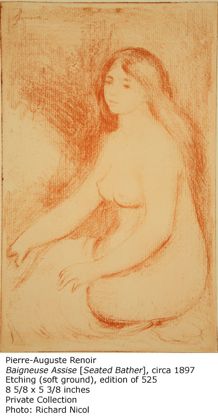
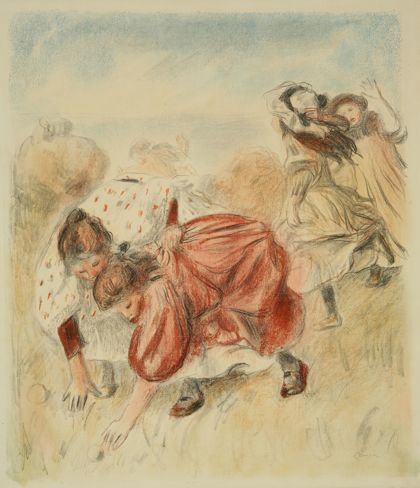
TAM’s current exhibition of Renoir’s prints is a remarkable loan from a private collector. It’s essentially a complete survey and represents two decades worth of work—the last decades of the artist’s life. Renoir came to printmaking later in his career, perhaps after he’d exhausted the possibilities of Impressionism, as he reportedly declared. You can still get a sense of the familiar strong colors of his painting in these works. A few of the lithographs, for example, reflect many distinct applications of color. But the appeal of Renoir as Printmaker is that it shows the artist moving beyond a reliance on color and experimenting with the possibilities of line and tonality.
A small case displays etching and lithograph equipment as an introduction to these printmaking processes. If you already know what you’re looking for, move on to the works themselves. They’re arranged in rough chronological order; occasionally, multiple versions of the same print are on view, such as the lithograph Bather, Full Length (ca. 1896). By comparing trial proofs to the final version, or different states to each other, you can see exactly how the original design shifted from one execution of the print to the next.
The freestanding wall in the middle of the space illustrates the more practical benefits of the painter’s venture into printmaking. All of the works hanging here were part of an album prepared by Renoir at the urging of his dealer, Ambroise Vollard, who had convinced the artist that he could reach a wider audience with prints than with paintings alone. Renoir was a sought-after artist, and print editions—multiple original objects made at one go—satisfied a market demand for his work.
I don’t mean to suggest that the economic benefits of printmaking outweigh the quality of the individual prints in the show. There are excellent examples of the artist’s work here, and they’re especially striking considering that many of these works were completed in spite of the artist’s rheumatoid arthritis, which in his last years became increasingly debilitating.
Three pieces stand out especially. The lithographic portrait of the sculptor Rodin (c. 1910) is so delicate, it looks as if the artist barely touched the stone. The transitions from dark to light, from paper to line, are so gradual, Rodin’s face seems to emerge slowly from the page. An etching from around 1895, Two Bathers, has the opposite effect. It’s composed of scraggly, frenetic lines, almost as if Renoir cut two lines at once into the ground; it’s far removed from the placid, sleepy nudes you see elsewhere in the show. Finally, a tiny lithograph, Odalisque (ca. 1904), isn’t quite your standard Renoir nude, either. At about three by five inches, it’s too small to offer much skin. The thick lithographic line and sharp contrasts between light and dark make the form dense and a little mysterious. It’s an eye-opener, like the exhibition as a whole.
Renoir as Printmaker: The Complete Works, 1878-1912
Tacoma Art Museum, January 17 – June 29, 2008
Link to Tacoma Art Museum
Heather Mathews is an art historian and Assistant Professor of Art at Pacific Lutheran University. She specializes in German art of the Cold War and writes about contemporary art, most recently for Glasstire.com, an online journal of visual arts.
Filed under: Museums, Tacoma Art Museum