Reviewing Tacoma's Mixed Use Centers
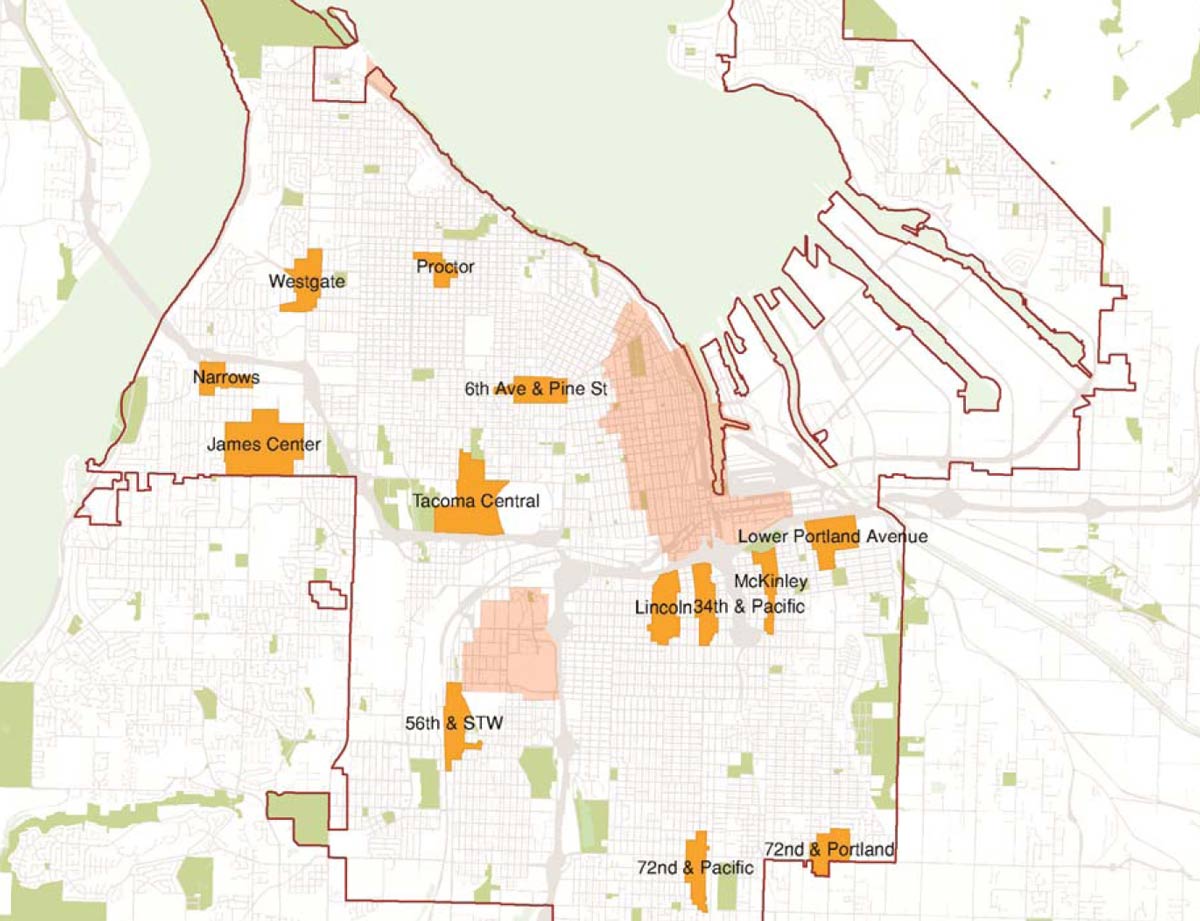
A review of Tacoma's officially designated Mixed Use Centers underway now could lead to a shift in the way these centers are treated within City code.
The current conversation is part of a much longer-term review of the centers, all focused on identifying and addressing barriers to development in the 17 MUCs identified in Tacoma's Comprehensive Plan.
The Comprehensive Plan designates these 17 areas to receive much of the growth expected in Tacoma over the coming decades. To accommodate this growth, the MUCs are zoned for higher density, non-automobile dependent development. The goal is for these neighborhoods to function more or less self-sufficiently, with a mix of uses to allow residents and workers to meet many of their needs within the neighborhood, without getting in their cars.
In order to drive development and density into these MUCs, and facilitate this pattern of development, the City offers a variety of incentives and different development requirements, including tax exemptions for multi-family developments, increased height allowances and decreased parking and setback requirements, increased transit and street investments, reduced parking, and other incentives to encourage development.
The problem is that development hasn't been coming along as quickly as hoped, hence the review of MUC standards.
Last year some incremental changes to the MUC code were made, aimed at lowering the threshold to development in these areas. Now the goal is a deeper review of the entire program.
Of the 17 centers, three (Stadium, Hilltop/MLK, Tacoma Mall) get pretty close scrutiny as part of subarea planning work, and one (Point Ruston) was just created in 2014. A Seattle firm is now conducting a review of the other 13 for the City, beginning with a survey of current conditions in the MUCs. In December, they presented work so far to the City Council Infrastructure, Planning, and Sustainability Committee.
Tacoma's Mixed Use Centers vary in terms of the mix of uses, housing and transportation options, quality and availability of amenities like parks and public spaces, and economic metrics. The Proctor District, for example, is the smallest of the 13 MUCs under review, with James Center and Tacoma Central many times larger in terms of acreage. The McKinley neighborhood, on the other hand, has the fewest jobs and lowest daily traffic.
There has been some talk of reducing the number of Mixed Use Centers. At this point the consultants seem to be leaning toward keeping them all, but prioritizing them in terms of growth potential with active or passive development strategies. The suggestion at this point is to develop an individualized development strategy for each of the MUCs, aligned with their individual opportunities and constraints. Some of these development strategies would be more passive, taking a back seat to those better positioned for development in light of market realities and other conditions.
Another suggestion coming out of this early presentation represents a bit of a shift in how we think of our mixed-use centers. Currently mixed-use centers are classified as one of four types: the downtown center, urban center, community center, and neighborhood center. The 13 being reviewed fall into either the community or neighborhood categories. The suggestion going forward is to instead change the classification system, categorizing the MUCs as neighborhood, crossroads, or employment centers. This shift would group the MUCs by how they are primarily used, rather than by the areas they serve.
James Center (the area around Tacoma Community College), would be an employment center, while Proctor would be a neighborhood center. 72nd and Portland, which is more commercial and car-oriented, and sits at the intersection of major arterials, would be a crossroads MUC. Not all of the districts can support multi-story mixed-use developments like the new Proctor Station project, and the suggestion is to be more flexible in the kind of development we expect - density could be increased by encouraging more compact development patterns, but not insisting on multiple floors.
It's not clear at this point whether the Council is on board with this idea of differentiating the kind of development expected between individual centers. There are concerns about equitable distribution of City investment, and about whether this shift might hurt the long-term vision for some of Tacoma's Mixed-Use Centers. Analysis will continue over the next year, with the consultants next expected to present to the council Infrastructure, Planning, and Sustainability Committee sometime in February or March.
It's a lot to take in, and there's more to come, so at this point we'll just leave you with the questions the consultants asked the council at the end of their presentation:
Are you comfortable, at least so far with -
- Not making vertically mixed use essential?
- Differentiating centers more clearly along form and function of center, rather than service area?
- Not focusing on eliminating centers, but instead developing individual redevelopment strategies and realistic time frames?
Filed under: Developments, City Government, Comprehensive Plan, Strategic Planning
9 comments
S Sid January 15, 2015
J Jesse January 15, 2015
J Jim C January 15, 2015
T talus January 15, 2015
X Xeno January 15, 2015
S Sid January 16, 2015
R RHTCCComedyfan January 16, 2015
T thackerspeed January 16, 2015
T thackerspeed January 19, 2015