SoTac: The Manitou Wailing Trestle

I have heard it isn’t much to look at; just big rocks piled upon one another to form a wall. Though impressive in size, this wall doesn’t hold anything up, keep anything out or hold anything in. Technically, as far as walls go, it is useless. Yet, if one were to try to clear these stones away perhaps to make way for something practical like a hospital or shopping center they would receive the wrath of millions of people. If someone was to propose dislodging these stones and cutting them into smaller pieces so they might adorn a fireplace or create a beautiful path, they would most likely receive death threats. You see, what is rubble in the eyes of one person is sacred in the eyes of another. And to discover what is sacred, it almost always takes a closer look.
If you move closer to this massive wall, you will begin to notice that the stones are outlined in blue and white. As one steps even closer, they see that the outline is created by paper; thousands of tiny scraps of blue and white paper jammed into every crack and crevice of this wall. And if one were bold enough to remove any one of these scraps they would begin to realize that the power of these stones is not in their size, but in their story. Each of these papers is marked with the prayers of people from around the world. They travel to this old wall to tuck their prayers into the cracks in hopes that God might notice their devotion and hear their request. But do not be fooled, this wall is not just a wishing well, a place to toss pennies. Rather, it is a place whose tragic history opens the way for people to express their own tragedies with the hope that they will not be forgotten. This wall is the last remnant of the sacred gathering place of the Jewish people. It is the sole surviving piece of their temple which was destroyed in the year 70CE. For almost 2000 years Jerusalem’s Wailing Wall has served as the only physical reminder of what was once the heart of the Jewish people’s world.
One doesn’t have to look too far in our own country to discover other places of communal lament. One doesn’t have to search long to discover spots where people can go to feel the weight of tragedy. Pennsylvania has Gettysburg Park, DC has the Vietnam Memorial, New York holds the locus of national lament at Ground Zero and Manitou has … well, Manitou has the trestle.
The Manitou Trestle
Almost 100 years ago the city officials needed a way to get the trolleys from South Tacoma Way out to what is now the American Lake VA hospital. Impeding this move was one of Tacoma’s economic lifelines; the railroad. One can only guess how the collaboration occurred, but the result was a right turn off South Tacoma Way onto 66th Street which dipped down twenty feet and then glided underneath a new railroad trestle. For decades this trestle divided the cars from the trolleys until the trolleys gave way to the ‘advanced technology’ of the bus systems. The rail was removed; the path was paved and probably looked very similar to what sits there now; with one exception … paint.
Somewhere along the way a kid with an artistic bent couldn’t resist the call of the concrete canvas the trestle presented. Try as I have, I’ve been unable to discover the nature of the first markings on this trestle. One lady told me that she thought it was Lincoln High School students proclaiming the athletic dominance of the Abes. Another person thought it was just the names of two kids in love. Whatever the case, those markings are now deeply entombed beneath layers and layers of paint. Since then, the trestle has served as the canvas for taggers, lovers and memorializers.
This is the trestle I pass through every day on my way to work and I will be the first to admit that this gateway into Manitou presents a less than desirable first impression. The railing is rusty, the paint is chipping, landscaping is sparse in some places and overgrown in others. And then there is the graffiti. Half-hazard and random, the walls are chaotic, uncoordinated and certainly unpleasing to the eye. This is all upon first glance, but what about when one looks closer?
Spray Paint Prayers
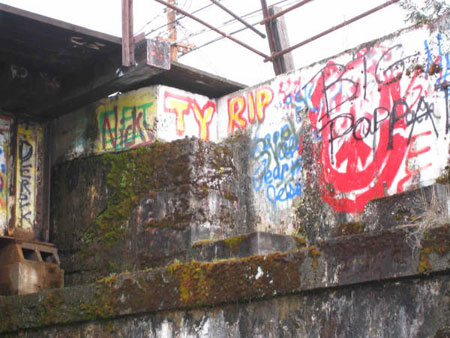
Upon further inspection, one realizes that tucked in the cracks and crevasses of this ancient structure are the names of people who once walked among us. In one corner there is the name Ty followed by the acronym RIP. To most passerby’s this name means nothing if noticed at all. But to hundreds of recent Mt. Tahoma graduates, this name causes a deep ache in the pit of their stomach. In early June of 2007, Tyler Howes, a two sport athlete at Mt. Tahoma was hospitalized with a rare illness. To the shock of everyone, he died on June 13th, the day he was supposed to graduate.
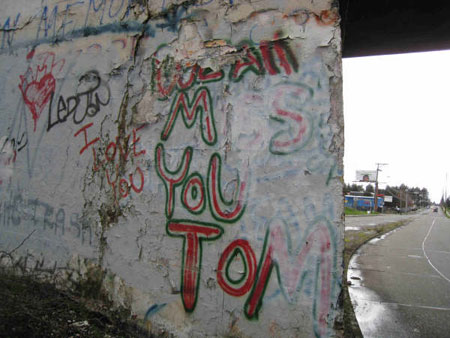
Move a little further around the trestle and you discover in red and green the phrase “We all miss you Tom.” On April 5th, 2007 long time Manitou resident Tom Creaser suffered a heart attack and died at the relatively young age of 52. Tom was a person who brought life to the Manitou community by coaching youth baseball and starting random wiffle ball games under the lights of the Manitou Elementary parking lot. I heard rumors it was his kids and a remnant of former wiffle ball players that honored Tom with these words.
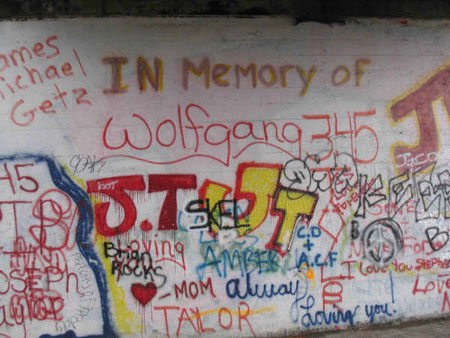
Move a little further around the trestle and you will observe other names of folks whose stories I was unable to discover. On the southern wall sits a simple blue inscription, “I [heart] u Nate.” Covering the northern wall in Mt. Tahoma crimson and gold are the words “In Memory of J.T.” As best I can tell, these words refer to Jason S. Taylor who died at the age of 30 on March 4th, 2005.
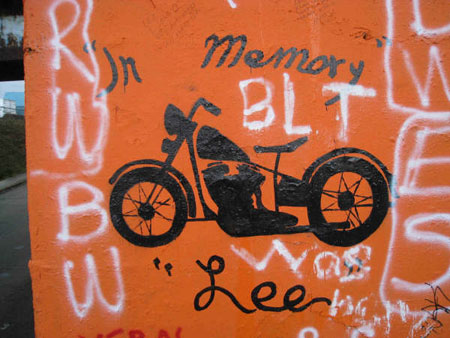
Perhaps the most notable recent addition to the bridge is the one that can only be seen by traveling east on 66th. As you leave the Manitou community you can’t miss the vintage silhouette of a Harley on a burnt orange background surrounded by the phrase, “In Memory of Lee.” It turns out that Lee refers to Lee Scearcy who was killed in 2008 doing what he loved, riding is Harley. To step further into Lee’s story, one only has to walk a couple of blocks down to the Sir-C Tavern at 62nd and South Tacoma Way where one can enjoy the ‘coldest beer in Tacoma.’ Upon one of the walls is a mural of four bikers, one of which is Lee. According to Lee’s son-in-law, Israel, all of these bikers have died in biking accidents in the last few of years.
Gateways
Were I an archaeologist, perhaps I could remove layer upon layer to discover the names of others who have been memorialized on this trestle. To be honest, this would be like dissecting a bird to see if it were alive. Just because these memorials are painted over doesn’t mean they cease to exist any less than the hidden prayers in the Wailing Wall.
I was with a group of folks a few weeks ago when the topic of ‘community gateways’ arose. We started to list some of the gateways to our neighborhoods. There is the 56th Street gulch that leads drivers from I-5 towards South Tacoma Way. There is the park at the corner of Tyler and Center that welcomes folks to the Oakland/Madrona neighborhood. And then there is the Manitou trestle that welcomes folks into the heart of this 4500 member neighborhood. What kind of welcome does this gateway provide to visitors? What kind of salutation does it offer when they leave?
To be very honest, there is one side of me that sees this decrepit gateway and concludes that the message people receive is that Manitou doesn’t care. The rail is rusty, the blackberries have taken over the hillside, the paint is chipping and the landscaping is unkempt. These things among others send the message that we are tired, we are busy and we’re neither happy nor sad you’re passing through. Were this gateway a person, it would probably just shrug and sigh as people passed by her.
But then there is that other side of me which I am glad to say is starting to gain more power. This side notices these spray painted memorial prayers and feels proud. This side feels honored to be a part of a community that cares enough about its fallen members to re-member them; that is bring them back into membership through paint, symbols and a little artistry. Were these memorials a person, they would be standing with open arms to all who pass by inviting them to come closer. This person would extend a hand and guide her guests and neighbors to look closer and notice that what seems like rubble is in reality sacred. And if one is courageous enough to look more closely to the rest of the community, they just might discover the same.
11 comments
S Sandy May 2, 2009
Your article captures the humility and unpretentious quality of this landmark, reminding us that such things are worthy of a close look. Thank you.
A alily May 3, 2009
I, too, pass through the “Manitou Gateway” regularly. When I first became part of this neighborhood I thought it was an eyesore. In the 2 years it’s been part of my commute, I’ve seen dozens, if not hundreds, of changes, and have come to appreciate the raw emotion it represents. Thank-you for so eloquently drawing attention to what has become one of my favorite local objects d’arte!
O offbroadway May 4, 2009
This is writing I read start to finish, and always come away with a fresh perspective and appreciation for something I had previously taken for granted. Thank you.
T Thorax O'Tool May 4, 2009
The only time I typically pass under the Manitou trestle is when going to Calvary for yet another funeral.
Not exactly a happy connection.
But I do usually try and read as much of the graff on the trestle as I can. Seen some sad stuff on there. It seems like all the memorials made are either for a war or they’re as dead as the people they are there for.
The fact that the trestle changes is a nice parallel with life itself.
D Douglas Tooley May 4, 2009
I am reminded of the debate in the Dome District regarding the Sounder’s extension through this urban neighborhood. One might think this balances slightly negative towards the neighborhood proposal for an open trestle.
However consider that Sound Transit proposal retains ‘A’ street as a pedestrian route via an underpass while blocking off the currently planned habitat and recreation corridor in the 705 Gulch. The 705 Gulch will be a very used connection.
Sound Transit hypes up their ‘A’ street underpass as a pedestrian connection, but it is a pedestrian connection to nowhere – connecting to a Freeway onramp (now also blocked from access)
For a great graffitti spot, look to the Eatonville rail corridors just to the South. These can be viewed from the Stanley Seaforts bridges on 34th.
I’ve heard that there is unblocked access from the Southeast, but haven’t confirmed. Rumored also is a short stretch of free flowing creek – which the City is aware of.
As the story goes.
D Darlyne Reiter May 4, 2009
Thanks, Ken. Reading your article reminded me of a time when I was on a train headed to LA. As often happens, trains get stopped for many reasons. As good fortune would have it, our train got stopped under an ‘infinity’ of tresles ~ each covered with graffiti. Each with a different story to pass the time. Although the Manitou trestle is only one, the multitude of stories are each priceless. Thank you for sharing. I will slow down when I go under the trestle and recall a life memorialized.
Darlyne
T troy May 5, 2009
Ken, I love the honesty that your trestle bespeaks! It reminds me of the shrines in our inner-city Atlanta neighborhood tied to telephone polls or staked at intersections. It reminds me of the bushes ablaze around every corner… Thanks
C Christine May 7, 2009
This type of public forum in invaluable. There was a simular beloved and “be-painted” trestle on 112th near Portland Ave. I added my own layer of paint to that one in the mid-80’s. That trestle was replaced a while ago and all of that history was lost. Everyone from the area was saddened.
Ah, the impermanence of things.
J Jesse May 8, 2009
At the risk of being extremely unpopular here, I see grafitti as something the ignorant do to help destroy their own neighborhoods. I don’t agree that it’s art. It’s crime against someones property. Sorry.
E Elliot Stockstad May 8, 2009
Great post, Ken. The trestle always reminds me of my CDL drivers test when I was behind the wheel of a big motor coach and the instructor took me there to challenge my knowledge of bus height. Would we fit under? Turns out we did, and in many ways your post is like that bus: A vehicle for taking us under the pain of a place. Thanks for paying attention and engaging us to do the same.
H Harlan May 9, 2009
Thanks, Ken. Your usual insightful self at work. Thanks for helping me be more observant of the “hood” in which you live and work but also of mine.