Tacoma Mall Neighborhood Plan Enters New Phase
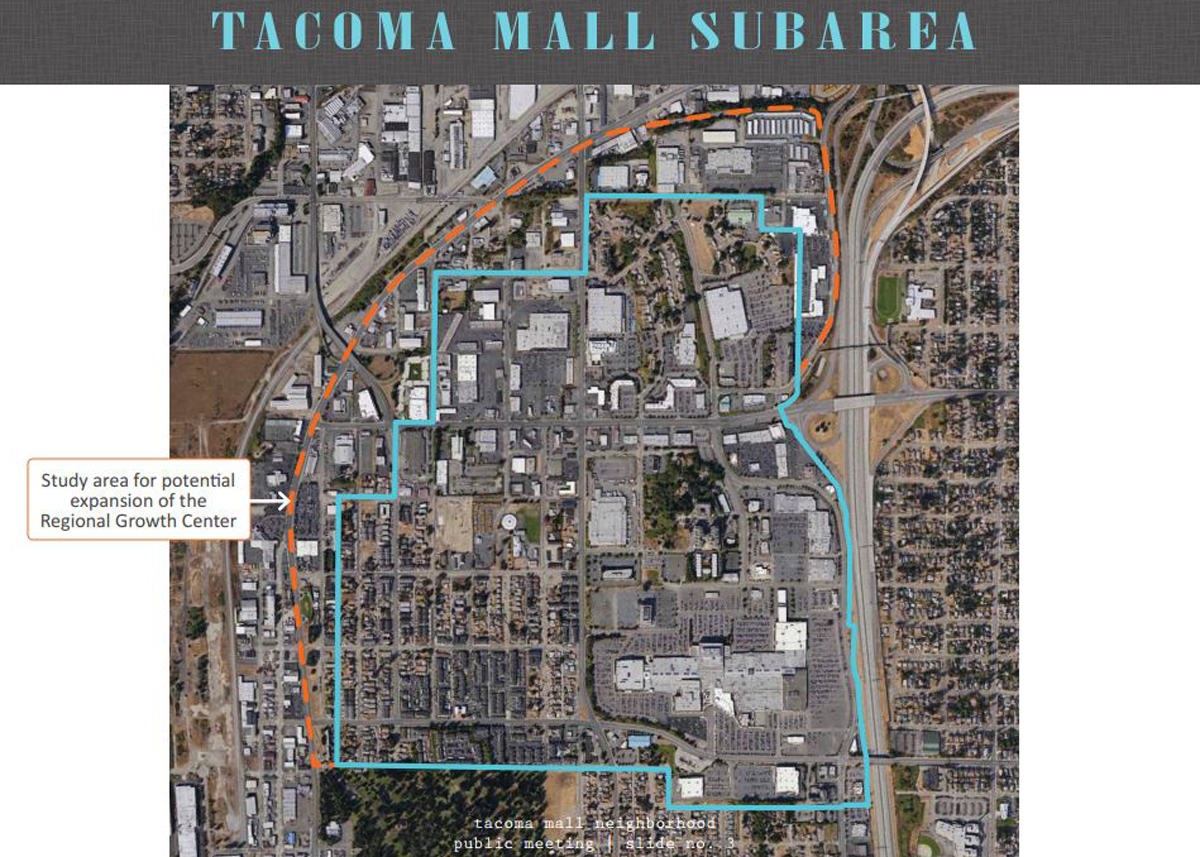
The City of Tacoma is in the process of developing a plan for the future of the area around the Tacoma Mall. Much of the second half of last year was spent gathering input from stakeholders and the general public on the project, which is now ready to move to a new phase - with a new round of public input.
Early data gathering and public visioning work are complete for the 600-acre area, including studies of traffic and transportation, development and market capacity; topography and view corridors; and preferences of residents, property owners, and other stakeholders in the area.
The process, like those conducted in recent years for Tacoma's north and south downtown and Hilltop subarea plans, will produce a plan identifying local and regional goals for the neighborhood, as well as environmental impacts of future development. The plan will include implementation strategies for achieving those goals, and mitigation measures for the environmental impacts, completing initial environmental approval for future development in the area, and smoothing the way for future development in the area, as it aligns with the plan.
The area is currently home to nearly 3,800 residents, and 8,300 jobs. As a regional growth area identified in the PSRC's Vision 2040 plan, those numbers are forecast to more than double. The plan developed will seek to layout a framework for accomodating that growth as the neighborhood makes the transition from fairly suburban to a denser urban form - ideally one that is more walkable and transit-oriented.
Early planning documents break the Tacoma Mall area into four smaller neighborhood quadrants, labeled the NW Quadrant, Lincoln Heights, Madison, and the Mall Area. Each of those area has unique characteristics, and unique challenges and opportunities that will need to be addressed in the plan. In all of these districts the plan will seek to promote development in coherent, cohesive urban form with complete street networks. Safety and livability, transportation connections, and improved image get mentions as overall goals as well. Individually, the documents point to unique focuses for each quadrant.
- NW Gateway - Promoting livability through reconfigured key streets and block patterns, with new development and amenities. There are mentions of establishing an urban district with green infrastructure, appropriate large-scale development, structured parking on the hilside, managing transitions to commercial/industrial uses on the perimeter, and plans to accomodate a new Sounder station on South Tacoma Way, if viable.
- Lincoln Heights - Reinforced neighborhood, with open space, and transitional building forms. Mentions are made of transitioning the existing dispersed 1950s housing to low- and medium-density residential, while retaining the curved street pattern with improved connections of streets. This could include a redevelopment of the Costco site that might allow for a reconnected street grid, parks, and green spaces as buffers between commercial uses on 38th, and residential streets. One interesting idea posed is to consider a “makers concept” area on the Pierce County properties, including small-scale industrial artisans, fabricators, and live-work opportunities.
- Madison - Reinforced neighborhood, retaining the existing grid pattern, and building on open public space. The goal here would be to retain the existing neighborhood block structure, while improving livability for residents. To accomodate growth, 38th would be targeted for taller buildings (up to 10 stories), while the southern end of the quadrant would get smaller buildings (up to 45 feet). Attention would be given to lot layout, integration of Madison into the neighborhood with a park or recreation center, traffic calming measures, and neighborhood scale.
- Mall Area - Strengthened retail draw, with entertainment venues, education, hotel, medical, residential, and other appropriate development. Supporting this goal would be an updated image, mixed-use infill with parking, public spaces, improved connections for transit and other modes of transportation; all with an eye to appropriate scale development. Also mentioned are a public park on top of the hill, an I-5 "slip lane" to Tacoma Mall Boulevard, a future light rail stop on Pine west of the mall, and turning Steele Street into a mixed-use, walkable boulevard.
These are just some of the concepts discussed, and nothing is set in stone yet. The project is now entering a new phase. From February to June the City will use this groundwork to develop a draft plan and draft Environmental Impact Statement. This phase will include a second round of focused community involvement.
Interested in learning more as plans develop? There's a presentation to the Planning Commission scheduled for tomorrow (February 3). This should be an opportunity to learn more details on where things stand now, and get a preview of what to look for in the next phase.
In the near future the City will announce dates for community involvement opportunities. Keep up to date on all that by checking the website, www.tacomamallneighborhood.com, where you can also sign up to receive email updates. Additional public meetings will be scheduled for March through May 2016. For more information, visit www.tacomamallneighborhood.com.
See something you like (or don't)? Is something missing? Now's the time to get involved. What would you like to see in this plan?
Filed under: Neighborhoods, South Tacoma, City Projects, Tacoma Mall Planning
15 comments
T talus February 2, 2016
T TACOMAROMA February 3, 2016
B Buck Futz February 3, 2016
T Terry February 3, 2016
T Timothy Smith February 3, 2016
T talus February 3, 2016
T Terry February 4, 2016
T thackerspeed February 4, 2016
D Donde February 3, 2016
T thackerspeed February 4, 2016
T Timothy Smith February 4, 2016
J Joe-Nate February 8, 2016
J Jesse February 9, 2016
A altered chords February 9, 2016
T talus February 9, 2016