Tacoma “Train-town"?
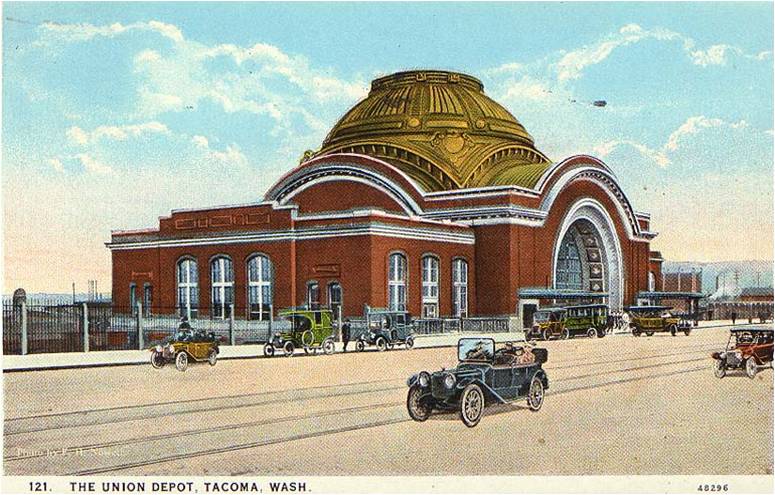
Image Courtesy of Michael Sullivan
As Tacoma celebrates the 100 year anniversary of our iconic Union Station this week, we wanted to share with you some historic perspectives on the meaning of the structure itself and the Railroad Era it symbolizes. Russell Holter is a local historian who has graciously provided us with this interesting history of the significance of rail in Tacoma. He spoke at yesterday’s centennial panel, and is the author of “Rails To Paradise: The History of the Tacoma Eastern Railroad (1890-1919).” Enjoy. – Dan
By Russell Holter
Recently, I had the distinct privilege of participating in a conversation between Michael Sullivan, Adjunct Professor with the University of Washington – Tacoma, and Jim Fredrickson, Northern Pacific railroad historian. In the course of our talk, Sullivan proclaimed, “Tacoma was once ‘Train-town USA’.” Looking for some validation to his remark, he turned to Jim Fredrickson and asked, “Wasn’t it Jim?”
At that point my interest was piqued. Was Tacoma really ‘Train-town’ or was Sullivan being dramatic?
Sullivan got the validation that he was seeking; however the kindly old gentleman politely corrected him by simply saying, “It still is.”
If I was intrigued before, I was even more so now. When train lovers romanticize about train spotting journeys they would like to embark upon, the list of inevitable localities often includes such heartwarming places as Chicago, Kansas City, Washington, D.C. or Scranton, Pennsylvania. On the West coast, Sacramento is the closest thing to a railroad Mecca. In Sacramento, thousands go to worship at the feet of the Gods of Iron at the California State Railroad Museum. But Tacoma? Not so much.
After giving it some thought, I had to concur with Sullivan: Tacoma was indeed Train-town and the explanation goes deeply and convincingly into our history. When President Franklin Pierce sent Washington’s first territorial Governor, Isaac Stevens, to survey a feasible rail route, everyone assumed that Olympia was the logical terminus. In 1864, when Abraham Lincoln chartered the Northern Pacific transcontinental route from the Great Lakes to Puget Sound, Tacoma wasn’t even a dot on the map. But the Northern Pacific Rail Road company had other ideas, and when railroad surveyors clearly staked out a route that stretched beyond Olympia, transcontinental terminal fever broke across the communities of the Puget Sound like an epidemic.
Though Tacomans will cite endless references to Commerce Club-like activities and land grants as the reason we were chosen, it cannot be overlooked that there were other dynamic forces at work as the railroad brass pondered the various villages of Puget Sound. Perhaps one of them had the potential to become the next Chicago, or the twin cities of Minneapolis-St. Paul; but intervening issues such as a national recession, labor unrest, inconsistencies of contractor work, and – ultimately – a congressionally-appointed construction deadline complicated matters.
Despite the wailing and gnashing of teeth by Seattlites, Tacoma was chosen as the most expedient location for a transcontinental terminus. Tacoma historian Herbert Hunt tells us that around Thanksgiving 1873, the first Northern Pacific construction train trundled down through Tacoma to the docks along City Waterway, arriving in a heap as the train proceeded to roll over onto its side. Thus the seeds of ‘train town’ were dubiously planted in Tacoma.
The transportation options available to Tacomans at the turn of the twentieth century are enough to make a modern commuter envious, especially in light of the traffic jams and the urban blight commonly associated with the automobile age. The railroads were building to a crescendo that would peak in another twenty years. Even the shortest of the commercial railroad lines, such as the sixteen-mile long Tacoma and Lake City Railroad, offered passenger service – even if it only ran from Tacoma to American Lake. We even had a cable car conveyance built into our streets to whisk pedestrians from downtown to Hilltop and back – a system just as useful and iconic as the historic system that San Francisco had the foresight to preserve.
The City of Tacoma was laced with more than 100 miles of improved streets and 130 miles of streetcar lines in 1900. Many of these miles actually overlapped, but for a city of Tacoma’s size, that was quite an accomplishment. Seventy years after the demise of the last streetcar, a trained eye can still find evidence of their existence not only downtown, but in nearly every suburb. Today, wide boulevards with small corner stores and oddly located neighborhood taverns still bear testimony to alighted trolley commuters of a bygone era who stopped to pick up fresh provisions for supper, or to whet a whistle, before walking home.
The trolley system in Tacoma began as a maze of private railroads each competing for crucial downtown access and exclusive service to a neighborhood or a suburb. Some of the streetcar lines, the Fern Hill and Puyallup for instance, were more than electrified trolleys. These actually provided steam-powered freight service as well. In 1899, after several incidents, accidents, injuries, and bankruptcies, several lines consolidated into a few larger organizations. From these mergers, the Tacoma Railway and Power Company was born. The Stone and Webster Corporation eventually consolidated all the lines in 1902. Over time these lines would ultimately morph into what was known as the Tacoma Municipal Belt Railway – more commonly known today as simply Tacoma Rail.
In 1902, the first-class high-speed mainline light rail commuter system called The Seattle-Tacoma Interurban was born, according to historian Warren Wing. With stations in Puyallup, Edgewood, Auburn, Kent and Seattle, the line was an instant success and only took two years to build – Imagine that! The Interurban system grew until it extended as far as Bellingham. Ultimately the automobile made the interurbans irrelevant, but the timing could not have been worse. The Great Depression came quickly thereafter, and folks who could not afford a car suffered without a cheap and dependable means of transportation.
But the glory days were truly glorious. No other period of time brought more promise of prosperity to Tacoma than that period between 1909 and 1911 when three transcontinental railroads arrived one right after the other. The Great Northern pushed through the Cascades to Everett, but much to their dismay, the railroad builders kept right on pushing southward to Seattle. Even though Seattle was chosen as the Great Northern terminus, trackage rights (via the Northern Pacific) were granted and railroad facilities were constructed at Tacoma in 1909.
The Oregon and Washington Railroad (a subsidiary of the Union Pacific), after a failed attempt to tunnel under the city, finally arrived in Tacoma from the south in 1910.
The Chicago Milwaukee and Puget Sound began clawing its way into Tacoma in 1909 from the east. Freight and passenger operations commenced in 1911, completing the last transcontinental railroad link perhaps ten years too late. Albert Earling, President of the railroad, wanted to start construction to Tacoma much earlier but the economic panic of 1893 put his plans on hold. By the time the westward expansion had begun, the costs of constructing a railroad had risen precariously, giving the Milwaukee Road (as it would be referred to) a rather shaky start. It would take seventy years and several bankruptcies before its demise became one of the single largest corporate failures in American history. Vestiges of the other railroads are still with us, but before you assume that the Milwaukee Road was a meager and beggarly little runt of a railroad because it arrived here late, you should ponder the question “Why build to Tacoma at all?”
The Chicago Milwaukee and Puget Sound had invested heavily in an up-start common carrier called the Tacoma Eastern Railroad and managed to eek out a rather profitable existence by linking no fewer than 27 sawmills between Tacoma and Mount Rainier. Two enormous sawmills were located in Pierce County: the National sawmill, near Ashford, and the biggest of them all – the St. Paul and Tacoma. Murray Morgan called it “The Mill on the Boot.” Now consider this: the Milwaukee Road pulled eighty-car trains of timber and other forest products off the flanks of Mount Rainier every single day for the better part of six decades. But this wealth was not the only draw to Tacoma. Another commodity vitally important to railroads was coal. The coal seams that run between Wilkeson and Carbonado don’t stop there; they continue southward stretching at least as far as Morton. At one time or another, at least four coal mines operated upon this route. The Tacoma Eastern also provided passenger service to Mount Rainier National Park (the train to the mountain). This passenger service continued steadily from 1905 until 1930 when it became another fatality of the Great Depression.
Though its time was short, the expansion in Tacoma was transformational for the Chicago, Milwaukee, and Puget Sound company. Within three years of arriving in Tacoma, its name changed to Chicago, Milwaukee, St. Paul, and Pacific, signifying a move to bigger and better things. But The Milwaukee Road did bring us two very lasting impressions: the beautiful, fast and stylish trains of the Olympian Hiawatha and the Columbian passenger trains that ran from Tacoma to Chicago.
In this prolific environment of railroad expansion and natural resource exploitation, it became apparent that the city needed a grand terminal station of the grandeur rivaling any in America. Hence the firm of Reed and Stem was commissioned to build Tacoma’s holy temple of transportation. Based in St. Paul, Minnesota, Reed and Stem were premiere architects uniquely suited to the opulence of railroad stations. They were the visionaries of the Grand Central Station in New York, King Street Station in Seattle and the Northern Pacific depot in Livingston, Montana.
Tacoma’s Union Station was commissioned in 1909 and completed in May 1911. Compared to the others Reed and Stem had built, the beaux arts station was smallish. But what it lacked in size it made up in magnificence. The ninety-foot central dome and the four graceful brick arches radiating outward to the four compass points are an inviting sight to both Tacomans and visitors alike. Ironically, even though Tacoma’s Union Station was built with the idea of being the central point for all passenger service into and out of Tacoma, the Milwaukee Road was the only railroad that did not use the station (except during the brief war years of 1917 to 1919 when the nation’s railroad system was federalized under the authority of US Railroad Administration). The reasons for Milwaukee Road’s exclusion were numerous, but the key factor was that a railroad had to buy its way in. The Milwaukee Road insisted on using the old Tacoma Eastern depot located at 25th and A Street (located beneath the I-705 freeway and 25th). The Milwaukee Road also insisted that they could build their own station to better serve their needs. They claimed to have plans at the ready for a new station at the corner of 25th and Pacific where the Pink Elephant is located today. Forty years later, they finally got around to it but built a modest station near the Port of Tacoma.
As we ponder Tacoma’s Union Station Centennial, we can conclude that Sullivan was right – Tacoma was Train Town. But we would be remiss not to examine Fredrickson’s assertion that Tacoma is still a train town.
Tacoma is served by three transcontinental railroads: the Burlington Northern Santa Fe, which is the most profitable railroad in America; The Union Pacific, which is the largest railroad in America; and – don’t forget – Amtrak. The Burlington Northern Santa Fe is an amalgamation of Tacoma’s Northern Pacific and Seattle’s Great Northern, which merged in 1971. The Santa Fe was tagged on the end like a caboose in 1997. The Milwaukee Road died an ignoble death, not unlike Caesar, on the Ides of March 1980. Some say it was slain from the cuts of dozen backstabbing Brutus’.
Tacoma is still served by Amtrak, on which you can ride the Coast Starlight to Los Angeles, or journey to Seattle to catch the Empire Builder to Chicago. Tacoma also hosts three regional carriers: Tacoma Rail – which serves Pierce, Thurston and Lewis Counties; Amtrak Cascades, the regional passenger service between Albany, Oregon and Vancouver, British Columbia; and the Sounder, which provides daily commuter service from Tacoma to Everett via Seattle. And the Link light rail, the first technologically advanced light rail system in the state of Washington, pays homage to the heritage of the Seattle-Tacoma Interurban. It may only provide inner city service at this time, but Sound Transit plans some day to link the Link that will take us all the way from Tacoma to Seattle.
Tacoma is also becoming more noteworthy as a place for train-spotting on the west coast, with idyllic places to photograph trains with stunning backdrops. Train photographers flock to Chihuly’s Bridge of Glass. It is both a terrific platform and an iconic backdrop to photograph trains. Other train-spotting localities include the Cable-stay Bridge, the Murray Morgan Bridge, and the Court A and Dock Street viaducts. The new parks at the head of the esplanade at Thea Foss, Reconciliation Park and Jack Hyde Park all make great vantage points for train spotting. But only the locals know that the best train-spotting in Tacoma is from the roof of the Sound Transit parking garage on Puyallup Avenue – Just don’t tell anyone I told you so.
Safe to say, Tacoma is Train Town. Now if only there was still passenger service to Mount Rainier National Park…
Filed under: General
17 comments
D Dale Wirsing May 3, 2011
An appreciative toot of the whistle to Russ Holter for this readable reminder that Tacoma was and still is “Train Town.” There was an effort 10 or so years ago to launch a community festival, Tacoma Railroad Days, but it ran off the tracks when no one could underwrite the infrastructure — office, phone, postage, printing, etc. Maybe this will revive some interest.
J Jesse May 3, 2011
Great article! Thanks.
L low bar May 4, 2011
choo choo happy train time
A Arm Chair Warrior May 4, 2011
Steilacoom is missing a huge opportunity to cash in on “train-watcher” tourism by letting their historic depot disintegrate. I guess the building is actually owned by the railroad (not the city) which couldn’t care less about it since trains, rails and buildings are only maintained as long as they make money… odd that it’s the public who is so nostalgic about trains but not the railroad companies, themselves.
C Chuck Morrison May 5, 2011
Great perspective Russ. We lose greatly when we ignore history.
Heading into the future it makes sense for us today to preserve the trace, if not the tracks, that still point to the edge of salt water across Dock Street. That was what the N.P. was chartered to do, and there is where it actually happened.
S Senior Cat May 5, 2011
And if we could just get the School Board to respect the old school buildings given to them…
M Mad Mike May 5, 2011
So… I guess nothing of interest happened at either the Council meeting or Citizen Review Panel this week… nothing? nothing at all going on of interest in the city..?
V Volcano Boycotting RR Anderson May 5, 2011
where’s the council meeting write ups! Humbug!
M Mofo from the Hood May 5, 2011
In the last days of Union Station when it was a working passenger train terminal, that building along with its late 1970’s downtown counterparts Trailways Bus depot at 8th and Pacific and Greyhound Bus depot at 14th and Pacific formed a basis for a trilogy of literary tragedy.
All three structures—-in terms of their physical function and the system of transportation within which each was an element—-were overcome by technological and social forces aimed at faster, cheaper, better transportation.
I’m speaking from personal experience as one who walked within the noted buildings when they functioned as transportation hubs. By the late 1970’s each terminal offered an alternative choice of transportation, but just not the best choice for a rapidly changing and mobile population.
Yet today we still hear proponents call out passenger rail travel as a viable choice. Let’s not get trapped in the cultural lag of those who would take our hard-earned pay from us to finance a tax based transportation system that is not faster, cheaper, or better than current choices.
Footnote: My father was a 30-plus year employee for Northern Pacific Railroad and its successor Burlington Northern.
L low bar May 5, 2011
tacoma gets a little bit of sun and everybody loses their minds. guess whats coming after the two month of summer? more rain ahahahahahahhahahahahahaah. you can cancel that tan and renew your autopay account at vintamins.com for 10000mg of SAD complex. hahahaha
A artifacts May 6, 2011
Great piece Russ and a thought directed at low bar’s image comment. Somebody needs to write a steam punk ghost story about the vacant graveyard of the NP shops at night. There’s a dark Gothic mythology around ghost trains and mysterious travelers but what about the generations of steamfitters and boilermakers that toiled in the brick sheds in South Tacoma. Are they completely gone? What goes on out there late at night in the moonless dark. Ethereal puffs of white steam hanging in the air,the spectral sound of heavy metal being struck by a wrench and the low groan of cooling iron. Train town yes but I miss the ghost of steam that Tacoma once understood better than anyplace.
T Tim Smith May 7, 2011
A mysterious “Iron Horse” is often seen near the old NP yards and can be spotted on South Tacoma Way. I can also afirm the very aura which one feels in the early morning crossing the mainline and walking out into the old yards and shops. The groaning sound is spooky the first time. Interstingly much of the below grade structures (such a inspection pits and steam raceways) remain although mostly covered over with dirt and blackberries.
L low bar May 8, 2011
i am always in awe of the groaning double rainbow express
J J Cote' May 10, 2011
A great article reflecting our past and current connection to rail. It’s sad, however that the powers to be chose to spent a butt-loal full of money (Talking hundreds of millions here) to carry passengers through downtown, following South Tacoma Way and bridging Pacific Avenue, bypassing the Ruston Tunnel and a glorious waterfront view, all to save 31/2 minutes of travel time. Absurd, asinine, illconceived and dumb are just a few words that will be written about this period of rail history in Tacoma a hundred years from now.
Thank you for a great piece.
L low bar May 10, 2011
where is obama’s meatpuppet moving super sonic rocket train to the progressive utopia? i think you get that sucker to pull into a station in tacoma and the feds are going to have to get their gubment teet sucking asses out of union station. i wonder if olympia constantly whines about being the state capital but getting no street cred?
Z Ziggy May 16, 2011
I really do appreciate local history and blogs like this are entertaining to know how old a building is and it past uses. This blogs really illustrates how past railroad has changed so much and we use the current rail. This was a delightful read thank you for the history lesson.
L low bar May 16, 2011
I would like to thank and be thankful. And thank thank thank. And thank you. And local history on this blog only goes back to 1890, and thank you for that. thanks:)