Tacoma Water Takes Steps to Find Where There's Lead in the Water
With the unsettling revelations around high lead levels in the water in Flint Michigan still very much in the news, citizens around the country are asking questions about what comes out of their own taps.
Tacoma Public Utilities is taking some initial steps to address these fears. In an update this week on their website, TPU provided new information on lead pipes within their service area.
The recent issues in Flint, Michigan have sharpened the focus on lead in drinking water across the country and prompted Tacoma Water to re-examine any remaining lead materials we may still have in our system.
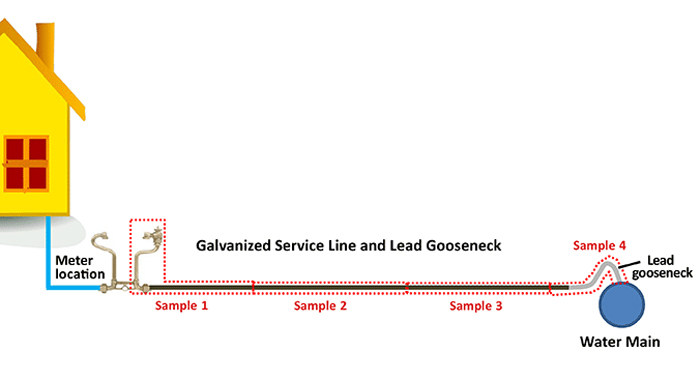
To do this, we proactively identified potential locations of lead goosenecks at four customers’ homes. Goosenecks are short sections of lead pipe (1’ to 2’ long) that were used in the early 1900s to connect some services lines to customer homes to the supplying water main.
As part of a service pipe replacement, we conducted special sampling of the water in the service line at these four homes before removing it. We found unexpected levels of lead in the samples we collected. We removed and replaced the lead goosenecks and the entire service pipes that connect the water main to the customers’ meters.
We have notified those customers, talked with our partners from the Tacoma-Pierce County Health Department and Washington State Department of Health, and we met with The News Tribune to provide information about what we found. You can readThe News Tribune's article online.
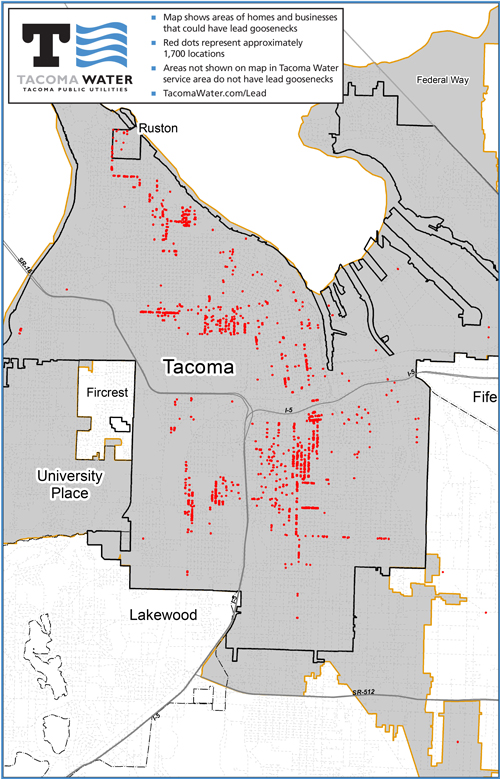
We estimate that there may be up to 1,700 (approximately 2% of customers) remaining lead goosenecks installed in our system. Records from that era did not include whether a lead gooseneck was used, so we will continue to sample and identify these locations.
Tacoma Water is working on a plan to pay for water testing at homes where the lead goosenecks are suspected to be present.
In the meantime, to help Tacoma Water customers decide how worried they should be about their own pipes, TPU has created a map of homes and businesses that could have lead pipes connecting them to the water supply. These 1,700 red dots represent home that might have lead pipes, not necessarily those that do. These are what remain of more than 30,000 connectors removed by Tacoma Water over the years.
If you're concerned about your pipes, Tacoma Water has a few tips for you while they work to determine where lead pipes are, and where they aren't.
- Run your water for at least two minutes before using the water for drinking or cooking after periods of six hours or more when the water has not been used at all. Bathing or showering is not a concern, and a shower will effectively flush the service line.
- Once the pipes have been cleared, run the water for 15 seconds before drinking or cooking.
- To protect privacy, the map doesn't show specific addresses or street names, but customers who thing their homes might be among the red dots can submit their contact information, and Tacoma Water staff will check their records for your location and respond.
For customers who would like to test their own water samples, there are two state-certified labs in Tacoma that accept samples from the general public and are certified to run drinking water samples for lead:
- Spectra Analytical Inc.
2221 Ross Way, Tacoma, WA 98421
(253) 272-4850 - Water Management Laboratories
1515 80th St. E., Tacoma, WA 98404
(253) 531-3121
The Tacoma Water page has a lot more information - background on Tacoma's water system, FAQs about this recent testing, how Tacoma compares to other places, and more broadly about how lead gets into the water. Read up on all this and more at tacomawater.com/lead.
Until now Tacoma has been following federally accepted best practices for testing for and mitigating lead in the water. The focus of these standards has been those homes deemed to be most likely at risk for having lead contamination - those built between 1982 and 1986. Those homes are of concern because they may have copper plumbing with lead solder. Older homes like the ones tested this time around were not the focus of testing.
Similarly, Tacoma has been following the industry standard for preventing lead in the water through corrosion control. This practice adds caustic soda to the water, raising the pH level to make it less corrosive on plumbing. The idea here is that less corrosive water means less lead dissolving into the drinking water.
This recent round of tests suggests that older homes do need to be tested. It also seems to suggest that the corrosion control practices currently used need to be re-evaluated too. Tacoma Water says that this evaluation, along with the testing already underway, is a top priority this year, for which they will bring in outside experts.
With testing already underway in Tacoma turning up troubling results, a number of other Puget Sound municipalities are now looking at their own systems - and making plans to begin their own testing. The TNT quotes a State Department of Health spokesperson, who "lauded Tacoma Water’s proactive approach to seeking lead in its system."
“Tacoma is one of those utilities that’s taking that seriously.”
Filed under: City Government, Public Safety, City Services
4 comments
B Bryan Jackson April 24, 2016
E Engineer April 25, 2016
E Eli April 26, 2016
R RW May 2, 2016