Washington State In Top 10 States For New LEED Certification
Washington State appears as number eight in the top 10 states for new LEED certifications in 2012 according to the U.S. Green Building Council (USGBC). Listed in the press release as a “significant project” certified in 2012 is Tacoma’s own Center for Urban Waters, which received the LEED Platinum certification last year.
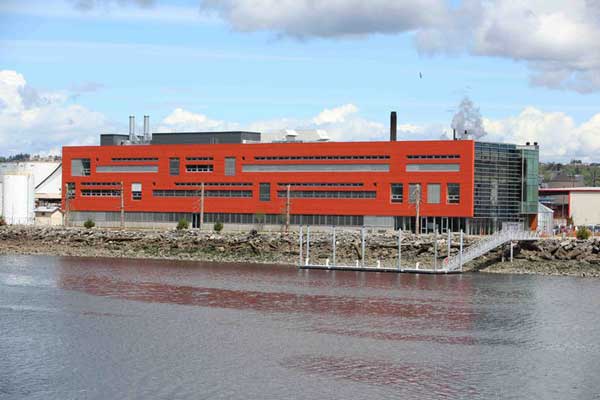
The rankings are based on per capita numbers of commercial and institutional LEED certified buildings. Washington State had 133 LEED certified projects (and we like that number), totaling 10,521,177 – that’s 1.56 square feet of LEED space for each Washington State resident certified in 2012.
Other LEED buildings in Tacoma certified in 2012 include the UWT Joy Building (LEED Platinum) and the Foremost Dairy Building (LEED Gold), and 130 other LEED certified projects.
Well done Washington, and Center for Urban Waters for being mentioned in the article.
Read more from the USGBC.
Filed under: Green Tacoma, Awards & Recognition, LEED
7 comments
J Jesse February 22, 2013
I personally learned a ton from the Urban Waters construction. After examining its $700 a square foot price tag, which is at least double the cost of a normal building, I put $400k into my own house to save a few bucks on the electric bill – you know, saving carbons and all. Now I have a $400k house that I’ve sunk $800k into. I’ll let you guess what kind of award I would qualify for for doing this.
J JJ February 23, 2013
One way to have a environmentally friendly house that uses much less energy is to make it very small like those California type Microhouses that are under 500 square feet.Something that tiny wouldn’t be very costly to build and would be relatively easy to have solar heating and solar electric panels on and use LED lighting.Pretty easy to super insulate such a tiny structure as well.
The larger the home the more energy is needed to heat it with the same type of construction.
I’ve even seen a bicycle RV that was under 88 square feet.
J jsisbest February 25, 2013
There’s been much written on the fact that the USGBC refuses to release data that it has been collecting on the energy efficiency of its LEED Certified buildings. This came about after it was published that several LEED buildings were performing worse, from an energy standpoint, than equivalent non-LEED buildings built around the same time. Bottom line, LEED does not equal energy efficiency. LEED has other merits, but as a certificate of energy efficiency it is not. USGBC has done an excellent job branding a certification process that is flawed, expensive, and yet ubiquitous. It’s time that designers, clients and owners (and government agencies for that matter) got a little more savvy about sustainability and quit relying on an outdated certification process to set the metrics. Global climate change is real, and buildings’ energy use is among the greatest contributors. But LEED Certification does little, if anything, to address this. It’s time to stop wasting tax payer money on rating systems and time to put the resources towards carbon net-neutral buildings.
F fred davie February 26, 2013
The urban waters building construction resulted in a roof leak that caused over a million dollars damage to the contents of the building. How many years/decades/centuries/millennia of saving a few pennies per month on the electric bill will it take to recover this million dollar unanticipated cost?
J jsisbest February 26, 2013
I’m confused… What does a broken pipe in an air handler (a standard mechanical equipment failure) have to do with investing in energy efficiency? And just for clarity, the financial savings provided by energy efficiency measures on large commercial buildings can be tremendous. Far exceeding the investment. But that’s not the only reason to invest in energy efficiency. Global climate change is real. If we don’t act now, we’ll have a lot more to worry about than just our return on investment in energy efficiency measures. Energy conservation is good economics, good environmental policy, will prolong the availability of our country’s natural resources, and reduce the demand/cost of resources as they become more scarce. I fail to understand why one would oppose policies that make our country more prosperous, secure, and environmentally sound.
J Jesse February 27, 2013
Urban waters is an environmental fiasco. If they decided to build it in an existing structure and retrofit it with super energy efficiency than they’d have half their money left and would have been able to insulate hundreds of houses.
Make no mistake, this is not energy efficient. It is, however, a study and experiment in energy efficiency.
J JJ February 27, 2013
Large buildings are not environmentally friendly just as heavy mass cars are not environmentally friendly.
Smaller and lighter is better.