What Makes a Place Livable?
Defining "livability" may be a bit like defining pornography: " I know it when I see it." Despite that lack of a consistent agreement on a definition (or maybe because of it?), it is worth examining our understanding of the concept of livability.
If you know it when you see it, who gets to do the seeing? What happens when two people or groups see different things? Where do our convictions about what defines livability come from? And where do they take us? What are the implications of decisions related to livability? The costs? Who pays?
When a topic leaves us asking more questions than we have answers, we know it's worth further examination. Fortunately for us, we'll have a chance to see the idea of livability dissected, discussed, and challenged at this year's forum from the Urban Studies program at the University of Washington Tacoma.
Every year UWT's Urban Studies program hosts a forum on issues impacting cities in our region. Past topics have included working waterfronts, urban universities, urban branding, transportation, and last year's illuminating forum on jobs and housing.
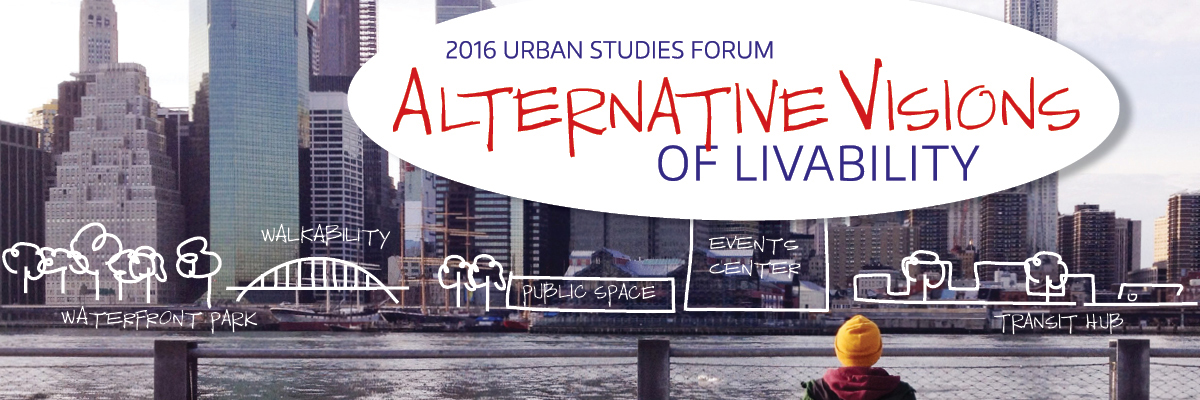
This year the forum focuses on questions related to livability. We can all agree we want our cities to be livable. What that means is a little harder to find consensus on...
For a city or a suburb to be livable, we assume certain characteristics and experiences. What are these and how do we define a livable place? Is there an agreement on what defines livability? The 2016 Urban Studies Forum will focus on these questions and what they might mean to the South Sound. In two separate panel discussions, we will focus on both the built environment dimensions of livability, as well as cultural and sociopolitical processes that produce them. Our panelists will debate various aspects of urban form, governance, social equity, and cultural productions that shape our perceptions of ‘livability.’
Questions of livability seem intertwined with virtually every urban issue: Do we allow high density residential development? Do we encourage it? Do higher density mixed-use developments make our neighborhoods more attractive - more livable - or less? How much parking do we require (or allow) with new developments? Does plentiful parking make a place more livable, or less? Who decides what makes a city more livable when environmental impacts come up against economic growth?
Sometimes, particularly when faced with the very real constraints of limited funding, space, and/or resources, conflict seems built into differing answers to these questions.
For someone using a single-occupancy vehicle to get around town and accomplish their errands, it may seem obvious that repaved arterial streets and abundant parking close to every destination would improve livability. On the other hand, for a person without a car, investments in curb cuts, public transportation, and sidewalks may seem like the obvious and absolutely essential priority. Is either more right than the other? How does a city find answers for both of these residents?
The two panels on the agenda for this year's forum promise to unpack these and other relevant questions sure to give you a few important things to ponder. Each panel will feature experts in a variety of fields, including local professionals who know the Puget Sound region, tackling issues of livability from two different angles.
Panel #1: Livable Built Environments
The built environment is, naturally, the most visible embodiment of the livability of a place. This panel will take a look at what physical elements make places - from city centers to suburbs - livable.
Questions will include: How can livability be understood within the diversity of places we choose to live? Who defines livability and for whom?
Panel II: The Role of Cultural Institutions in Creating Livable Communities
When we talk about the livability of a place, we often reference contributions of that place's cultural institutions. Sometimes it's the more obvious contributions: theather on the square, or summer festivals. Sometimes the contributions of these institutions are less obvious.
This panel will examine what contributions from cultural institutions can be, and their potential for generating positive impacts. It will also take a critical look at what works and what doesn't when it comes to these kinds of initiatives - in general, and in our region in particular. Topics will include:
Questions will include: What is the role of cultural institutions in regenerating urban and suburban spaces? How do they produce livable communities? What are some successful examples? How do we define success? What are some examples of ‘less than successful’ initiatives? What separates the two? Does scale matter? Where do Tacoma and the South Sound stand in this regard?
Keynote Lecture
Keynote speaker Jason Schupbach is Director of Design Programs, Visual Arts Division Team Leader for the National Endowment for the Arts. He will deliver a keynote on livability that promises to tie together the threads of livable built environments, the arts, and the role of cultural institutions in cities in our region and beyond. Find his bio here.
It seems obvious that we all want to live in livable places. We see the idea of 'livability' raised in virtually ever conversation about decisions in Tacoma, in the region, and beyond. Does the new Proctor Station development make its neighborhood more livable or less? Will cutting McMenamins a deal on our historic buildings yield a more livable downtown? Does the proliferation of marijuana businesses in Tacoma make our city more livable or less? Would protecting the spacious layout of west Tacoma's Narrowmoor neighborhood make the city more livable? Did the painting of guerilla crosswalks make Tacoma more livable?
Some things are easier to agree on. Maybe we can all agree that Monkeyshines makes Tacoma more livable. But how, then, do we foster that kind of creative energy? What's the secret?
Maybe we'll learn it at the forum... You'll only know if you attend.
Filed under: Arts, UWT, Events, Get Involved, Colleges & Universities
15 comments
J Jim C January 28, 2016
A ApitbullnamedPlug January 29, 2016
A altered chords January 30, 2016
A ApitbullnamedPlug January 30, 2016
J Jim C January 30, 2016
A ApitbullnamedPlug January 30, 2016
E Engineer February 1, 2016
J JDHasty January 29, 2016
B BiblicaProduct January 29, 2016
J Jim C January 30, 2016
E Engineer February 1, 2016
T thackerspeed February 2, 2016
A altered chords January 30, 2016
J JDHasty February 12, 2016
J JDHasty February 12, 2016