American Black Bears Welcomed Home to Northwest with a Salmon Feast
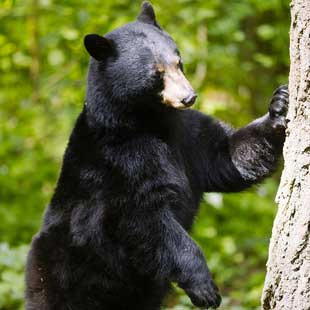
It didn’t take long this morning for a 6-year-old American black bear to spy a tasty, sockeye salmon, grab it with his sharp, 2-inch claws, tuck it between his long teeth and saunter into the forest with it for a solitary banquet.
Meanwhile his sister positioned herself on a log, slurping down strawberries and crunching on red delicious apples.
The local-foods feast was part of a special “Welcome Home to the Northwest” event for the Oregon-born bears, who recently arrived at Northwest Trek Wildlife Park.
After two weeks of getting accustomed to their 1-acre, lushly forested exhibit, they made their public debut at the wildlife park this morning.
The now-400-pound male and 250-pound female lived at the Topeka Zoo since they were orphaned as cubs and rescued in Oregon six years ago.
But they’re not in Kansas anymore.
They eagerly scratch their backs on 100-foot-tall Douglas firs, forage for insects in rotten logs, splash and swim in three pools, sometimes standing in the water while eagerly lifting their brown muzzles to the sun. They crash through the forest, knocking down brush and creating trails of their own. They sometimes wrestle and tussle with one another or chase each other around the brush. And they delighted visitors this morning, stretching high up trees to snare food and lick honey off of the bark where keepers so thoughtfully placed it.
“These are young, active, athletic bears and they bring a renewed vibrancy to Northwest Trek,” deputy director Donna Powell said. “They’ve clearly taken to the forested exhibit that was built specifically for black bears. And they’ve arrived at the perfect time of year for the public to come to Northwest Trek and view them.”
They are the first new black bears at the wildlife park in 20 years.
“These are the only American black bears in an Association of Zoos & Aquariums accredited zoo in Washington state,” Powell said. “We’re pleased that our visitors will be able to see them in a forested exhibit typical of black bears’ native habitat.”
Conservation education is at the core of Northwest Trek’s mission, and the wildlife park’s newest residents also will help zookeepers and naturalists inform the public about black bears, which are native to much of the United States and Canada.