Be a nature hero by becoming a Citizen Scientist
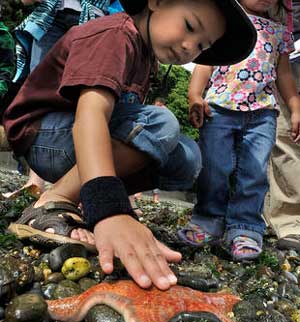
On a clear, warm day, a group of children, teens, and adults fan out with clipboards along Owen Beach, scouring the rocks, the pilings, and the shallow water for clinging and crawling creatures.
They are observant. They are happy. And they are learning more about the world around them while also making a crucial contribution to the living body of scientific data.
These are Citizen Scientists, and they have gathered on this particular day for Explore the Shore, one of Point Defiance Zoo & Aquarium’s four programs designed to involve ordinary people in extraordinary research efforts.
Over the last four years – from Commencement Bay to Mount Rainier _ more than 3,500 people have joined in the Zoo’s Citizen Science mission to link local residents with nature and contribute to wildlife research.
“These programs get people outside and connect them to wild places and wild animals,” said Craig Standridge, the Zoo’s coordinator for public programs and visitor studies. “And at the same time, they’re also doing something to help wildlife.”
Now, courtesy of $65,000 in donations by generous patrons at The Zoo Society’s Zoobilee last summer, these programs will be accessible to more people in 2016. Some of the funds paid for the Zoo’s purchase of a 10-passenger van to take volunteers to wildlife research sites. The remainder of those donations will pay for equipment and staff time.
The Zoo’s Citizen Science effort began in 2011 with a 24-hour “Bio Blitz” – an event that brought together multiple agencies and scores of volunteers to learn about, count, and track every living thing at Point Defiance Park.
The event was so successful that Zoo staff members met with the state Department of Fish & Wildlife to brainstorm future programs that would assist research and engage the community.
The result was a steadily growing list of programs that allow people to get involved for a day or for a few hours every month. They can sit to observe and record nature in some spots; wade into water at others; or climb strenuous trails in pursuit of animal information at other sites.
For some projects, volunteers attend training sessions in advance to learn about observing the animals and collecting data. These volunteers can then track species in places, and at a level of detail, that the Fish & Wildlife Department’s limited staff might be unable to reach.
The Zoo continues to look for ways to expand Citizen Science programs, Standridge said, and likely will focus on sites within Tacoma “to inspire a lot more conservation, knowledge, appreciation and action for the benefit of the local wild area and animals.”
HERE’S HOW TO BE A CITIZEN SCIENTIST
Sign up for programs in February, March and April
Pre-registration is required for all programs except Explore the Shore. E-mail zachary.hawn@pdza.org or call 253-404-3690 for more information or to register. All programs are free.
EXPLORE THE SHORE: A low-tide walk along Owen Beach reveals an array of marine life for volunteers to record for Washington’s NatureMapping database. This event is for ages 5 and older.
Dates and times for 2016 are:
Monday, June 6 at 11:45 a.m.
Wednesday, June 22 at 12:15 p.m.
Wednesday, July 6 at 12:15 p.m.
Thursday, July 21 at 11:45 a.m.
Tuesday, Aug. 2 at 10:30 a.m.
Thursday, Aug. 18 at 10:45 a.m.
Go to www.pdza.org/explore-shore for more information.
SPOT THE SWALLOWS: Learn about feeding and nesting habits of purple martins at sites along Ruston Way and Titlow Beach. Attend the workshop from 2 p.m. to 4 p.m. April 3, then complete monthly surveys from April to August.
MONITOR THE MARSH: Venture into local wetlands to spot amphibian egg masses— key indicators of environmental health. This family-friendly event is available for ages 8 and older. All gear is provided.
Dates and times for these Citizen Science Saturdays this year are:
Feb. 20 from 1 p.m. to 3 p.m., location to be determined
March 19 from 1 p.m. to 3 p.m., location to be determined
April 16 from 1 p.m. to 3 p.m., location to be determined
Volunteers may attend just one session, two sessions or all three.
PEAKING FOR PIKAS: Visit the Cascade mountains to search for this furry, squeaky, alpine-dwelling mammal. You must attend the training session from 2 p.m. to 4 p.m. April 30 before completing at least one pika survey.