Fort Nisqually Honors Volunteers
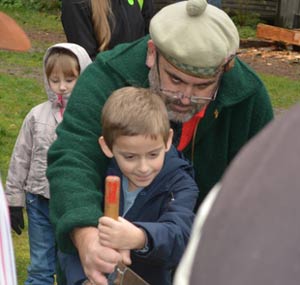
Fort Nisqually Living History Museum named Art Cherry as 2014 Volunteer of the Year during a January 17 volunteer appreciation dinner.
“It was completely unexpected,” Cherry said.
Fort Nisqually Site Supervisor Mike McGuire said, “Art was everywhere during the year – interpreting at our public events and on non-event days, and doing whatever was needed around the Fort. I think he chopped close to a cord of wood for Fort stoves.”
Cherry, 52, has been volunteering at Fort Nisqually for 20 years. He vividly remembers his first weekend, at Brigade Encampment in August 1994. “I remember standing in the dark and listening to the sounds of the camp,” he said. “I knew I wanted to be part of it.”
Cherry keeps volunteering. “It’s the sheer joy of doing it,” he said, “and of being part of the Fort family,” he said. Cherry’s sons, Chandler and Cole, also became part of the Fort family. They began participating in events when they were 2 and 3 years old. Cole, now 15, participates in the Fort’s Apprentice Interpreter program.
Cherry said to have his efforts acknowledged was unexpected but appreciated. “We don’t volunteer for the awards. We do it because we love it,” Cherry said. “To be recognized by this group of people is extra special.”
More than 120 members of the Fort’s volunteer family attended the appreciation dinner. Numerous volunteers received recognition for their contributions during the past year – both behind the scenes and as interpreters for the public.
Many of the volunteers are re-enactors, just like Cherry. “On their own time, and often to great depths, they research the history of the Fort and aspects of daily life in the mid 19th century,” said Event Coordinator Chris Fiala Erlich, “but what is truly special is the joy they get out of sharing their acquired skills and knowledge with the public and other volunteers.”
Volunteers include families with young children, teens, and retirees. Depending on their interests, they have become practitioners and interpreters of various 19th century crafts including cooking, sewing, spinning, blacksmithing, woodworking, gardening, gunsmithing, wet-plate photography, leatherwork, and scrimshaw. Some make powder horns, rope, candles or soap. Others play fiddles, dulcimers, flutes or banjos.
Cherry said he will keep coming to the Fort as long as he is able. “It’s not something I plan on giving up anytime soon. It’s family.”