NW Trek Deputy Director Leaves Legacy of Inspiration and Advocacy
Dave Ellis, Deputy Director of Northwest Trek Wildlife Park, died Tuesday. He was 65.
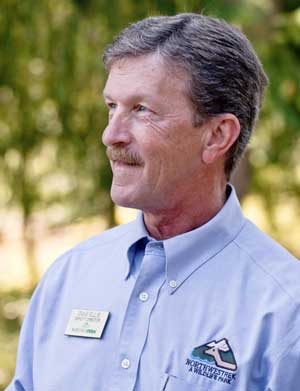
He leaves an indelible imprint on the 723-acre zoological park he loved. He dedicated two-thirds of his professional life to Northwest Trek, having arrived at the wildlife park near Eatonville on Jan. 17, 1985.
He died on Northwest Trek’s 37th anniversary; July 17 was a date he celebrated every year for the contribution the wildlife park has made to the local community and to efforts to preserve a variety of species.
With nearly 28 years at Northwest Trek, Ellis served the wildlife park, its animals and its human visitors for close to three-quarters of its existence.
He was a tireless advocate who was always searching for the next project, another animal survival success, the best way to educate the public about conservation and instill in them a love of the outdoors.
During his tenure, the park grew tremendously in animal collection and in local and national standing as a premier zoological and educational facility.
Northwest Trek staff deeply grieves his loss, but the park remains open to the public, continuing to do the job they learned and honed under his leadership.
“He had the type of personality that touched a lot of people,” said Gary Geddes, director of the Zoological and Environmental Division of Metro Parks Tacoma, which oversees operation of the wildlife park.
“I believe that he and our team, through day-to-day management, protected the original dream that Northwest Trek benefactors David ‘Doc’ Hellyer and Connie Hellyer had when they donated this incomparable piece of land to Metro Parks,” Geddes said.
“Every day, he managed toward the protection of Northwest Trek and the concept of what it was established to be,” Geddes said. “He was unwavering in that commitment.”
Ellis was a U.S. Army veteran who brought his military skills, a bachelor’s degree in biology and prior zoo management experience in El Paso, Texas; Wellington, New Zealand; and West Palm Beach, Fla., to Northwest Trek.
He was hired as general curator and became deputy director on Jan. 1, 2000.
“Dave Ellis was a tremendous asset to Northwest Trek and the greater community, a stalwart advocate for wildlife, a warm, caring friend and a valued member of the Metro Parks Tacoma family,” said Metro Parks Tacoma Executive Director Jack Wilson. “This is a great loss for all of us, and our thoughts are with his family and all of his coworkers.”
Ellis led the wildlife park through nearly three decades of change – in size, in attendance, in animals and exhibits – while keeping animal welfare and conservation as core constants.
Those changes included:
- Cat Country, with cougar, bobcat and endangered lynx, in 1987
- Barn owl exhibit in 1988
- Cheney Discovery Center for children in 1989
- Forest Theater in 1991
- Wolf exhibit in 1992
- Grizzly and black bear exhibits in 1993 – the year Northwest Trek set an attendance record of 210,356
- Picnic pavilion completed in 1995
- Hellyer Natural History Center, a laboratory/classroom open to students, scientists and the business community, in 2000
- Coyote/red fox exhibit in 2003
- Acquisition of an additional 100 in 2005 for conservation activities
- Installation of a recovery project for the Oregon Spotted Frog, thanks in part to an endowment Ellis helped win in 2008
- Zip Wild zip line/challenge course, which opened last weekend
The addition of the bear exhibit in 1993 was one of Northwest Trek’s biggest – and most popular – accomplishments under Ellis’ direction, Geddes said. Its construction was a team effort and it was built in-house. The exhibit still draws admiring reviews from zoo-design professionals, Geddes said.
It was immediately loved by the public, a fact proved by attendance figures that year.
More recently, Ellis’ leadership was instrumental in a collaborative effort to preserve the Oregon spotted frog by giving the endangered species a head start before release into the wild. He passionately believed it’s not too late to make a difference in the survival of the once-abundant amphibians.
But perhaps his most enduring legacy is the long record of solid and successful accreditation reports from the Association of Zoos & Aquariums (AZA), Geddes said.
“We got our first accreditation in 1985, and it was because of the work he did,” Geddes said.
AZA accreditation is crucial because it distinguishes a zoological park as a premier facility worthy of and eligible for participation in animal reproduction and other conservation programs. Fewer than 10 percent of the approximately 2,400 animal exhibitors licensed by the U.S. Department of Agriculture are accredited by the AZA.
Ellis was known throughout the wildlife park and in the larger Metro Parks Tacoma organization as a warm, compassionate, caring man, Geddes said.
He was an outdoorsman who came even more alive with a fishing line in the water, skis on the snow or hiking boots on a trail. Ellis, Geddes and Northwest Trek Operations Director Chip Heinz climbed to the summit of Mount Rainier together in 1986.
Ellis also was active in and passionate about the community in which he worked and lived, having served on the Eatonville Town Council and on a number of committees, boards and other civic groups.
Whether he was working at Northwest Trek or in the community, Dave Ellis showed the same true-compass character, Geddes said. It was a trait many emulated.
“He had a sense of professionalism that inspired people every day,” Geddes said.
###
Northwest Trek, accredited by the Association of Zoos & Aquariums, is a 723-acre zoological park dedicated to conservation, education and recreation by displaying, interpreting and researching native Northwest wildlife and their natural habitats. The wildlife park is a facility of Metro Parks Tacoma and is located 35 miles southeast of Tacoma off State Highway 161.