SHARKMANIA! Features an All-New Touch Experience
They perfectly complement the largest warm-water shark exhibit in the Puget Sound region and the popular Eye-to-Eye Shark Dive experience that opened last fall. So, what’s all the buzz about?
TOUCHABLE SHARKS:
For the first time ever at the zoo, there are sharks people may touch. Whitespotted bamboo sharks and epaulette sharks glide through the waters of Stingray Cove, and visitors can dip their fingers into the pool to feel the sharks’ sandpaper-like scales. They range from about 18 inches to 3 feet long.
Sharks and stingrays are cousins, and the touchable sharks will swim in the pool with dinner-plate sized stingrays, which visitors also may touch.
The small sharks aren’t aggressive, so visitors needn’t worry about being nipped. Likewise, the stingrays’ barbs are clipped, so people can slide their fingers over the rays’ velvety bodies without fear of being stung.
THE BUZZ SAW SHARKS OF LONG AGO:
Imagine a behemoth shark with strong jaws and teeth in the shape of a circular saw, ideally suited for first crimping its prey and then ripping it apart.
It sounds like the stuff of science fiction or B-rated horror movies. But the Helicoprion was very real, a huge cartilaginous fish that grew up to 25 feet long and roamed the Permian seas in the Paleozoic era 270 million years ago.
Now, it has come to life again through an exhibit in the zoo’s North Pacific Aquarium.
The Buzz Saw Sharks of Long Ago exhibition is grounded in science while at the same time springing from the lively imagination of Alaska artist Ray Troll, who has persistently pursued details of the gigantic prehistoric shark for more than two decades.
The exhibit features fossils from the Idaho Museum of Natural History and sculpture by Gary Staab in addition to Troll’s artwork.
It is rooted in more than a hundred years of study and very recent scientific research, fusing the inquisitive minds of paleontologists with reconstruction work accomplished by powerful 21st century CT scanners.
Four fossils - one as big as an automobile tire - show the elaborate whorls, or tooth structures, of Helicoprion. These fossils were dug out of phosphate mines in Idaho. The exhibit also contains three casts of priceless fossils, including one that was key to learning the actual dentition, or arrangement of teeth, in the strange-looking sharks.
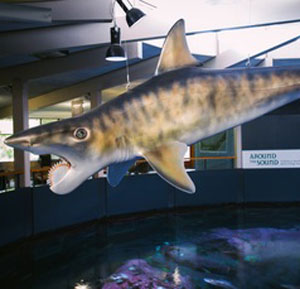
A 15-foot-long prehistoric shark sculpture hangs over the main tank of the North Pacific Aquarium. Five ratfish, the shark’s living relatives, swim peacefully in the pool below.
And that big fiberglass shark swimming in the air over them? Well, he’s just the baby of the exhibit.
Nearby, a huge Helicoprion bursts out of a wall, giving the impression that its head and upper body are on one side, while the rest of the shark is on the other. The toothy, fearsome side visitors see is about 14 ½ feet long and about 8 feet high. That would make the whole shark a 24-foot behemoth.
On another wall, a 17 ½ -foot-long-by-8-foot-high mural painted by Troll shows an ocean full of the huge sharks and their prey.
More than 20 pieces of Troll’s art hang on the North Pacific Aquarium walls, which were hand-painted for this exhibit by Troll and a cadre of volunteers.
Waves and images of sharks and other sea life help immerse visitors in the Buzz Saw Sharks of Long Ago experience.
MEGALADON MOMENTS:
A 6 1/2-foot high replica of a megalodon shark jaw stands on the floor of the North Pacific Aquarium, where visitors can step inside to appreciate its size – and snap a few photos. It’s a jaw-dropping experience.
AN AQUARIUM FULL OF SHARKS:
Seventeen sharks glide around the tropical waters of the 240,000-gallon South Pacific Aquarium. A large lemon shark, about 9-feet long and weighing around 450-pounds swims effortlessly through the water, her pectoral fins sweeping up a bit at the ends, similar to the winglets on a large aircraft. Her aquarium mates include a toothsome sand tiger shark, three sandbar sharks, a blacktip reef shark, a Japanese wobbegong, or carpet, shark, and 10 nurse sharks. Visitors can see shark feeds at 11 a.m. Tuesdays and Saturdays.
EYE-TO-EYE SHARK DIVES:
Divers from 8 through adult and all experience levels can immerse themselves in the world of the zoo’s 17 sharks and get closer to the animals than ever before. No experience is necessary to slip a dry suit on over street clothes and step into a cage while breathing surface-supplied air. Cage divers – ages 8 and up - get a wonderful view of the sharks while standing underwater in a sturdy cage. Certified scuba divers – 15 and up – swim into the shark exhibit with a diver guide for an even closer look at the sharks. Prices are: Cage dives, $60 for zoo members, $75 for non-members; Scuba dives, $160 for members, $175 for non-members. Online reservations are required and may be made at www.pdza.org/dive.
The shark touch experience is a permanent addition to the popular Stingray Cove, which opened last summer. The whitespotted bamboo sharks and epaulette sharks will join about a dozen dinner-plate sized stingrays in the touch tank.
The Buzz Saw Sharks of Long Ago will remain at Point Defiance Zoo & Aquarium through Dec. 31.
The shark touch experience and The Buzz Sharks of Long Ago exhibit are free with zoo admission.
“We’re pleased to present SHARKMANIA! to our guests,” said John Garner, the zoo’s education curator.
“We know they will find it both intriguing and fun and we think they’ll walk away with the joy of discovery.”
But there’s a very serious message in the exhibits, too.
An estimated 100 million sharks are killed each year for their fins, meat, liver oil and cartilage, as well as from overfishing. Millions of those are killed specifically for shark fin soup, a delicacy in many parts of the world.
“Conservation is at the heart of this exhibit,” Garner said. “Sharks are crucial to the ecosystems of the world’s oceans. We believe visitors who touch sharks, learn about sharks and are captivated by the story of 270-million-year-old sharks will be inspired to take action to protect these animals,” he added.
Helping sharks can be as simple as not buying shark fin soup, shark cartilage pills or souvenirs like shark jaws; writing to Congressional representatives about strong federal laws to protect sharks; and buying seafood harvested using sustainable practices that avoid harming sharks.
For more information about sharks and ways to help them, go to www.pdza.org/savesharks.
For additional details about SHARKMANIA! go to www.pdza.org/sharkmania.