Signs highlight the diversity of trees in Tacoma’s Wright Park
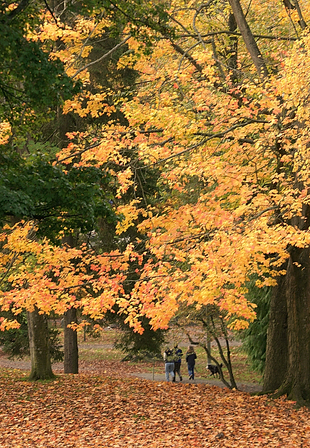
Arboretum collection dates back to 1898, includes 27 champions
It’s hard to imagine what Wright Park looked like in 1886 when the Tacoma Land Company donated the vacant land for a public park.
Its 27 acres were barren, muddy and likely devoid of native trees, which had been logged off for commercial sale.
But conditions attached to the gift required that at least 300 ornamental shade trees be planted on the grounds within four years. Soon after that, experts brought in additional trees from throughout the United States and parts of Europe.
That was the start of the Wright Park arboretum, where now 138 species of trees are nurtured for educational display and public appreciation.
A number of the largest specimens are nearly as old as the park itself. Want to know which ones? Just read the newly installed signs. A recently completed tree tagging project ties most of Wright Park’s more than 600 trees to its history. Each of about 450 trees bears a label that identifies it by its scientific and common names, its geographic origin and the year it was planted in the park.
For example, what is probably the park’s most famous tree, nicknamed the Roosevelt oak, standing close to the W.W. Seymour Conservatory, at 316 S. G St., is labeled “1903.” The tree was planted in honor of President Teddy Roosevelt, who visited Tacoma that year.
Most of the signs are attached about 10 feet above ground level. Many hang facing park paths, making them more visible to walkers and runners. Light-colored signs indicate champion trees, meaning those recognized for dimensions outstanding for the species, or are historically significant to the park. Other signs are brown and blend unobtrusively into their surroundings.
“Just by walking around, you will get a sense of the arboretum’s diversity,” said Mark McDonough, Metro Parks’ urban forester. He catalogued each of the trees in a descriptive database before the signs were hung.
Metro Parks is developing a new brochure that will highlight many of the so-called champion trees, lay out a walking tour and include a map. The brochures probably will be printed in early 2016 and will be available in the Conservatory and at metroparkstacoma.org/arboretum.
But you don’t have to wait for the brochures to check out the new signs and appreciate the arboretum’s long history.
McDonough suggests starting at the Conservatory and walking along South G. Street. “Take a look at the red oaks,” he said. “The size of them is astounding. And not just the Teddy Roosevelt.”
His other favorites include the American beeches, found throughout the park; the purple beeches, along Sixth Avenue, east of the park’s bowling green; and the rock elm, also near the bowling green, with its deeply furrowed bark and its narrow, cylindrical shape.
“I would encourage spending an hour or two, walking around, reading labels and stepping back to view trees as a whole, ” McDonough said. It’s a good way to take a break from the cyberworld. Learning about trees doesn’t require special equipment. “It’s enjoyable for any park user.”