November 13, 2015 ·

City OKs New PSE LNG Facility

This week the Tacoma City Council approved an agreement allowing Puget Sound Energy to build a liquefied natural gas facility on Port of Tacoma property at East 11th Street and Taylor Way. 

PSE wants to build the natural gas liquefaction and storage facility on the 33-acre site on the Blair-Hylebos Peninsula in the Port to meet customer demands and to provide LNG to the nearby TOTE marine facility, according to City documents.

The facility would receive natural gas from PSE’s distribution system, chill the gas to produce approximately 250,000 to 500,000 gallons of natural gas into liquefied natural gas (“LNG”) daily, and store up to 8 million gallons of LNG on site. The LNG would be available for use as a reduced‐emissions fuel for marine vessels and land‐based vehicles, as well as for utility peak shaving during periods of high demand.

Natural gas would arrive at the facility via an existing PSE natural gas pipeline distribution system, with two new segments to be added to serve the facility. One mile of pipeline in unincorporated Pierce County would connect two existing lines, and four miles of pipeline would extend from Fife into Tacoma to reach the new facility.
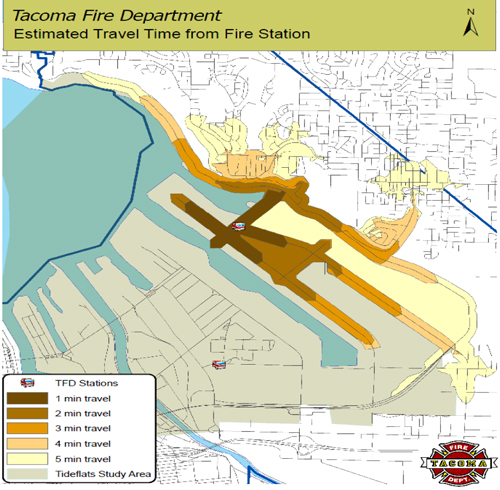
The City's Environmental Impact Statement on the project, which lays the groundwork for state, federal, and local agency decisions still to come on the facility, analyzes potential environmental impacts and recommending actions to mitigate those impacts. Three actions are highlighted as of "paramount importance":

  1. The reopening of Fire Station 15 at East 11th and Taylor Way
  2. The complete reconstruction of Taylor Way from State Route 509 to East 11th Street to current "heavy haul" standards
  3. The installation of an "Intelligent Transportation System" (ITS) that can inform public safety agencies as to vehicle and train status in real time.

The old Fire Station 15, which has sat unused for several years now, would be refurbished at PSE's expense, and reopened with a new number (to avoid confusion with the new #15, which will continue to operate up the hill on McKinley) using revenue collected by the City from the LNG project. As was explained at this week's council meeting, reopening the fire station would significantly improve response times within the Port and Northeast Tacoma. The proposed location of the PSE facility is currently in the Fire Department's worst response time within the Port.

PSE will also be required to fund approximately half the cost of rebuilding Taylor Way. The City and the Port will work together in the next four years to find funding for the remainder of the cost of rebuilding that road and for the installation of a basic ITS, either through grants or a local improvement district.

PSE would like to begin construction on the project before the end of this year, and hopes to have the plant operational by early 2017.

Filed under: City Council, City Government, Port of Tacoma, Public Safety

24 comments

  • talus November 13, 2015

    Good luck putting out a "fire" at an LNG plant. More like an explosion too close to too many people. Why can't we use the Tideflats for shipping things rather than siting combustibles and polluting industry right by bay, near downtown and NE Tacoma residential areas, and in a tsunami and liquefaction zone in the case of an (inevitable) earthquake? The days of Tacoma being an industrial sacrifice zone should be over, but are they?
  • Xeno November 13, 2015

    Study any of these facilities and they are never located next to urban centers like us. While a better fuel for tankers that run on diesel I'm deeply saddened how the Port of Tacoma Commissioners represent us as the place where all the explosive toxic chemicals go while Seattle ramps up freight terminals all in the spirit of not competing against each other. City unfortunately seeing $$$ for Taylor Way and the reopening of the Fire Station in lieu of safety. But hey, lets put a LNG facility on a flood plain, liquified soils, and a lahar zone and call it safe.
    • Timothy Smith November 14, 2015

      We put over 1200 people in prison down there daily with no approved escape plan...what is wrong with a little gas?
  • Optimist November 15, 2015

    I share your distrust of state and city leadership, but cynicism is lazy, and the concept of having CNG at the port is too appealing to not play devil’s advocate. The safety of CNG is at least as good as gasoline, and is better in vehicle accidents and fires. And anyway, the Port presently has large fuel tanks that contain more explosive fuels like gasoline and diesel sitting in the identical location/situation. (And these are refilled by diesel-burning tanker trucks traveling on congested roads and rails.) Natural gas is flammable, but not as explosive as gasoline or diesel: when a CNG tank leaks, it escapes into the air rather than leaching into the soil and water. Replacing these with CNG, with the source of production right where it would be consumed, seems like a better way. Pierce Transit been making its own CNG for its fleet right off of South Tacoma Way for the past 15 years. Having our city buses not burn diesel fuel has improved our air considerably, especially downtown. There was one mishap at their facility in 2011, but gas and diesel tank fires happen just as well as CNG, and usually turn out worse. If CNG were readily available at the Port, more companies will likely use it for their fleets of vehicles and equipment because it costs half as much. And... it would be better for the environment in an area that could use a little of that! Obviously, intelligent people have put this very-expensive and complicated project together, wagering that it will be a long-term success. Without a doubt this facility will be engineered and built to the most updated seismic and ‘environmentally-responsible’ specifications, and inspected a multitude of times during construction and afterwards by a long list of State and Federal agencies (DOE, EPA, ATF, etc, etc.) Perhaps with a gauntlet like that to run, no stone will be left unturned. And who knows, the facility might create jobs either directly or indirectly.
    • Timothy Smith November 15, 2015

      Yes we should believe in the good faith and trust of intelligent people, however, we have no one with such expertise on the City of Tacoma staff. The blathering excitement to create jobs and use a more clean and "green" energy has led to short-cuts, exceptions, and exemptions for many other projects in the past. I doubt that has changed. For example, having old Fire Station 15 reopen in such a threatened area makes little sense. One would think, and it was pointed out during hearing, that the supporting fire station cannot be and should not be in the danger zone. Putting all the high tech response gear in the blast, tsunami, and liquefaction zone means it is lost in the initial "unforeseen" event. I am just surprised that NE Tacoma folks haven't descended like howling banshees from their lofty homes to protest. https://www.youtube.com/watch?v=Z0FgRJXj0m4
    • talus November 15, 2015

      I might trade this facility for existing dangerous and polluting uses of the earthquake- and tsunami-vulnerable Tideflats, but doubling down on inappropriate siting of dangerous stuff in a dangerous and sensitive area does is a bad strategy for creating a healthy economy and environment in Tacoma.
    • Optimist November 15, 2015

      Granted: no one on the Tacoma city staff is expert on this stuff. But in order to build such a facility, outside entities including the Federal Government do have to get involved—am I wrong in assuming this? That THEY have people on staff that will tell the city they are jaded and greedy, and also disallow the Fire Station 15 scheme if that’s true? (The EPA has a reputation for being somewhat prickly.) Is CNG worse than what we have now? Natural gas pipelines already go to the Port, equipped with shut-off valves upstream and out of danger. Lessening the stockpiles of more-explosive liquid fuels down there would simplify the “unforeseen” situation rather than make it worse. It takes 3000 degrees to cause CNG to explode, compared with 536 degrees for gasoline/diesel—and CNG doesn’t seep into ground water. And while we’re waiting around another 50, 75, or 100 years for Mt. Rainier to explode or an earthquake to happen, why not explore the possibility of giving the Port a cleaner, less expensive fuel to use? Right now they need all the help they can get. (Btw, tsunamis aren’t much of a concern to us in the Puget Sound; the last one happened in 900AD.)
      • Timothy Smith November 16, 2015

        EPA oversight? Federal Regulation? Okay...you must work for PSE or their subcontractor and are probably commenting anywhere this issue arises. Your Tsunami information is dated (pun intended) and you should look at the recent research and studies. As you suggest a coastal tsunami may not be as threatening, however, Puget Sound has its own internal geological conditions that present an even more dangerous scenario with little or no warning time. A landslide in 1894 generated a 10-foot wave that led to three deaths, destroyed freight docks, and caused significant damage in historic downtown Tacoma . In 1943, another submarine landslide produced a tsunami that destroyed jetties at the mouth of the Puyallup River. 3-7 minutes after a major 7.3 quake on the Seattle or the Tacoma Fault a nice wave inundates. See the video: http://www.king5.com/story/news/local/2014/07/31/12954692/
    • Xeno November 16, 2015

      My cynicism I believe was pretty well grounded in fact, more fact than relying on our lovely professional experts. That's a pretty weak argument anyways. I'm sure Fukushima or Hanford had experts speaking to the viability of those sites. Let's be clear we're talking LNG not CNG, let's at least get the facility correct. The facility is 8 million gallons (far above the needed fueling capacity of current Port of Tacoma traffic) and in a catastrophe does become airborne but also becomes a cloud ready to ignite if air is stagnate. This is far larger of a facility than the Williams site that exploded in Plymouth, WA last year. Additionally, while it is great to get some emergency coverage from Fire Station 15 there is nothing that TFD can do in a catastrophe to even respond to this facility. Due to climate change the location of this facility is expected to be underwater, it is located on soils that can liquefy the structures during an earthquake, and it is still in the lahar zone. 8 million gallons is too much. This facility will really become a LNG export facility after a few tweaks and we'll be shipping natural gas to China in no time. Again, not necessarily against the clean fuel nature of this facility, it just shouldn't be located in an urban area. Plymouth, WA had to be evacuated when the Williams plant exploded. How are we evacuating Tacoma again?
  • Joe November 16, 2015

    So apparently, unless Timothy approves of it, we will only have stores that allow you to play with Legos and other tinker things with children who are not your own?
  • RHTCCComedyfan November 16, 2015

    Like Johnny Rotten of the Sex Pistols said in his old song God save the Queen "Potential H-Bomb"
  • Optimist November 16, 2015

    Like I said, devil's advocate. Thanks for your illumination and cynicism. Reminds me of the Tacoma I love. Please illumine me further Xeno what the scientific difference is between natural gas that is released from LNG and CNG? Seems like it would be the same thing once it is released.
    • Xeno November 16, 2015

      LNG is more energy dense than CNG, when it transitions into an airborne state it also leads a trail back to its source, which can't be put out (effectively an ignited leak would have to burn out 8 million gallons of LNG at this facility). CNG dissipates better than LNG since it doesn't have to switch states during a leak. LNG relies on refrigeration that can fail in prolonged power outages while CNG doesn't. My issues aren't so much the differences between these two states of natural gas, it is the location of such a facility in a catastrophic prone area. The City of Tacoma is playing the beggar in this transaction as lead agency. Look at the mitigations. They do nothing to address safety and complexity of this facility.
    • Optimist November 16, 2015

      Thank you for further educating me and the public. I'm really on your side on this, it is an outrage. So you're saying that LNG is 2.4x denser than CNG, (1/600 the volume of natural gas), and that you can't run vehicles and equipment on it directly because it is cryogenically stored at -260F rather than in canisters like CNG? So the intent of this facility is not to serve the port, but to get PSE into the growing global LNG market? And in the event of a natural disaster where the refrigeration is cut off, the magnitude of of 8 million gallons of this would cause a plume that would spread over the entire port area and probably Commencement Bay (8million x 600...), bigger than any fire station could help with? ; ) Thank you for your knowledge of the accidents have happened in our region, and what is possible for us. Its hard to keep up with the news stories. Maybe we need people like you on the City Council! I believe I'd even vote for you (and I'm not being cynical, even though born and raised here!)
      • Xeno November 17, 2015

        Sounds like you're well versed in this as well. I do enjoy the devil's advocate position, we don't debate these issues enough in our community. Sadly though the debate for this is almost over. Council has signed the interlocal agreement with the Port of Tacoma on a consent agenda vote. I think this would have been a more ideal project say for the Port of Port Angeles or Port of Anacortes where the population centers are lower and in less environmentally risky areas. LNG is a good fuel, just not in urban areas. I thank you for your future vote though! My hope is Tacomans don't take every opportunity at the cost of our safety. Council couldn't resist the forbidden fruit though. Taylor Way will look nice, we'll get some state of the art ITS notification system, and a Fire Station that can get there 5 minutes faster than our existing fire stations to really do nothing to respond to the safety concerns of this facility.
  • altered chords November 17, 2015

    What was the combustible used in the explosion at the foundry in the Nalley Valley a few years back? I was at a soccer game in Puyallup and I heard the massive explosion. What was that combustible?
    • Phil B. August 17, 2016

      Atlas was a propane tank, where the nozzle wasn't properly fitted to the tanker truck, leading to an explosion. The truck driver died if I recall. He was very close to retirement. You allude to the main problem with LNG: LNG is cryogenically frozen (-260 degrees) 600 times shrunk natural gas. Incidents are most likely with hoses, fittings, & fueling operations. If Tacoma's urban center is to become the largest hybrid bunkering facility in the nation, which is what they are trying to sneak in under our noses, we're going to have alot of hoses, fittings & fueling happening, greatly multiplying the risk. The LNG catastrophe in 2004 in Algeria underscores that LNG facilities should be nowhere near populations, nor anywhere near crude oil storage. This is exactly what we have existing at the Port of Tacoma. If we were in the EU, siting criteria would curb &/or prohibit this project. Most concerned for those working or very close to the tank (it will be as large as the Tacoma Dome). I then feel sorry for those who have homes within a mile. This operation will be visible & well-known. It could lead to a significant drop in property values. The Port of Tacoma has wasted nearly 6 years now playing with unfeasible fossil fuel export projects. They need to look to the future, instead of locking in Tacoma's polluted past.
  • some_guy November 17, 2015

    that was CNG, which was accidentally ignited due to faulty equipment during a refilling of an onsite storage tank.
  • RHTCCComedyfan November 25, 2015

    Look at RR Anderson's latest Tacomic at FeedTacoma titled "Thanks Giving Conspiracy Roundup 2015" He has hyperlinks that shows a related proposed Methanol plant that will use more water than all the residential customers.Be sure to read these. http://comics.feedtacoma.com/tacomic/tacomic-thanks-giving-conspiracy-roundup-2015/
    • Timothy Smith November 26, 2015

      Thanks for the link. Amazing that this plant will use more water than all the City residential users. Given this usage a special fee or surcharge seems to be in order maybe to help pay for infrastructure upgrades. Though somehow I see them getting some special discount and a cheap rate. That seems to be how the City gets taken every time.
      • RHTCCComedyfan November 26, 2015

        You know we were under a slight water restriction this year.Just think how bad the water restrictions will be when this monster is in operation. Maybe our water rate costs will double on our utility bills (limited supply and high demand). Plus consider the other aspect and hazard (possible fire and explosion) of it producing 20,000 tons ! of methanol daily. I don't know how this hazard compares to the liquid natural gas hazard of the PSE LNG facility but it seems to me to be also a target that a terrorist would have glee into choosing.
  • JohnSherman November 30, 2015

    So where is the citation hyperlink to the Municipal Corporation Port of Tacoma LNG facilities hazards analysis? for example, something created like: http://www.energy.ca.gov/reports/2003-07-17_700-03-005.PDF
    • talus November 30, 2015

      Good link, John. There's some sobering safety info about LNG hazards in there.
  • RHTCCComedyfan January 12, 2016

    Just remember folks Robert Jesse Hill wasn't the kook who approved this insane facility.It was was your supposedly sane city council members. Remember that at election time.Look at the LNG hazard area on this page.Wow I am glad that I am not in the blast zone.Too bad for those who are. https://www.facebook.com/NoWaterForMethanol/